
NOTE: The sponsor of this content may contact you with more information on this topic. Click here to opt-out from sharing your email address with this sponsor. (This link will not unsubscribe you from any other BIC email list).
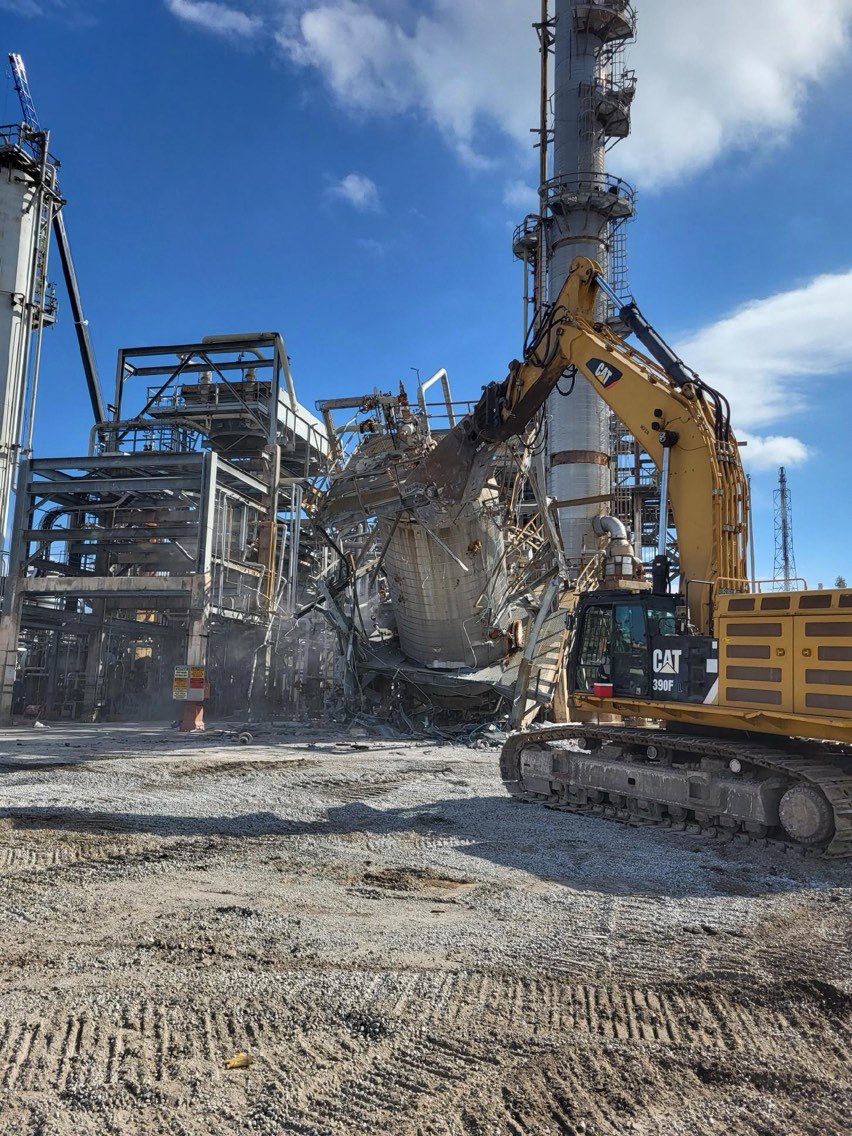
There is a particular kind of demolition work that does not get a lot of attention in the trade press. It does not involve imploding a stadium or dropping a smokestack. It happens quietly inside operating refineries and chemical plants, often within a few feet of equipment that is still in service, and it is judged not by what comes down but by what stays untouched.
Jackson Demo
For plant operators and management, this is the type of demolition that matters most. A unit is being retired, a vessel is being replaced, a structure is being cleared to make way for a capital project. The scope looks routine on paper. But the work is taking place inside a facility that is making product every hour of every day, surrounded by live process equipment on multiple sides. The measure of a good contractor in that environment is not how fast they can remove the target. It is how disciplined they are about everything they choose not to touch.
Demolition is a subtractive business, but the thinking is additive
A common misconception about industrial demolition is that it is the opposite of construction. You build things up; you tear things down. In practice, the mindset required to demolish inside a live plant has more in common with construction than most people realize. The crew must think ahead, in sequence, with a clear picture of every system that surrounds them and how each piece they remove changes the condition of what remains.
Good demolition planning starts with a question that sounds simple but rarely is: what is still going to be here when we are done, and how do we make sure it stays in the condition we found it?
The answer involves live pipe racks running overhead. Pedestals and foundations must remain intact because they will support the new build. Instrumentation, cable trays, and sample lines that are easy to overlook until they are damaged. Structural members that appear redundant until the wrong cut turns them into the only thing holding something else in place. Fire monitors and gas detection systems must remain in their exact factory-sighted positions throughout the project.
A contractor walking that scope for the first time is not just estimating the work. They are building a mental inventory of what needs protection, what needs coordination, and what could go wrong at every stage.
Physical protection is unglamorous and decisive
Most plant operators have seen the same handful of protective measures used on demolition sites: debris shields, fire blankets, and continuous water application during cutting operations. What they may not appreciate is how much of the job’s success depends on the quality of these measures and the discipline with which they are used.
Debris shields are often custom-built on site from wood and other available material, angled to deflect falling debris away from protected piping. They are simple in concept but require real thought to position correctly. An improperly placed shield either fails to protect what it was meant to protect or creates a new hazard, especially when the shield itself is flammable and hot work is happening nearby.
Fire blankets do the obvious job of protecting surfaces from spark and slag, but they also buy the crew time to respond if something unexpected ignites. Continuous watering during torch work keeps surfaces cool and reduces the risk of heat transfer to adjacent lines. None of this is cutting-edge technology. It is craft knowledge, accumulated over thousands of hours of working inside live facilities, applied consistently by crews who know what happens when it is skipped.
There is also a less obvious form of protection that experienced contractors rely on: reusing material from the demolition itself. Refractory removed from a furnace or vessel can be repositioned as a protective bed over pedestals and foundations, absorbing impact during heavy pick operations and creating a working surface that machines can traverse without damaging what is underneath. It looks improvised, and in a sense it is. But it is the kind of field judgment that separates crews who have done this before from crews who are learning on the job.
Sequencing is a safety decision
The order in which a structure comes apart is not just an efficiency question. It is a safety question.
A well-sequenced demolition leaves the most hazardous cuts for last. That means the work that requires the tightest clearances, the most careful coordination with operations, or the highest risk of affecting a live adjacent system is not attempted on day one. The crew works its way toward those cuts deliberately, clearing the surrounding area first so that when the critical work happens, the environment around it is as open and controlled as possible.
This approach also minimizes the amount of time hazardous conditions exist on the site. The longer a partially demolished structure sits with unstable members or exposed hot work points, the more opportunity there is for something to go wrong. Good sequencing shortens that exposure window by making sure the final, most sensitive cuts happen when the crew is set up, the permit is current, and the plant has the fewest simultaneous activities in the area.
Plant operators who have watched contractors work on their sites can usually tell within a day or two whether the sequence is thought through or improvised. Crews that are thinking ahead move with purpose. Crews that are reacting to what they find as they find it generate permit changes, schedule slips, and unplanned coordination meetings.
When hot work is off the table
In some areas of a plant, hot work is not a question of permits. It is simply not allowed, or it is allowed only under conditions that make it impractical. That is when mechanical cutting, cold cutting, and non-traditional removal methods move from being options to being the only path forward.
Cold cutting covers a range of techniques that use mechanical force, hydraulic pressure, or abrasive methods to section material without introducing an ignition source. Each method has its own trade-offs. Some are slow. Some generate more waste. Some require staging space that may not be available in a congested work area. A contractor who is prepared for live-plant work carries multiple cutting methods into the field as a matter of course, because the right tool for a given cut is often dictated by conditions that cannot be fully assessed until the work is underway.
The same applies to lifting and rigging. A structure that would normally be sectioned on the ground and hauled out in pieces may have to be lifted out whole because the footprint below it is off-limits. A vessel that would normally be laid down for further processing may have to be cut in place and lowered piece by piece because the surrounding infrastructure cannot support a horizontal staging area. These are not unusual conditions. They are the everyday reality of working inside a plant that was designed to run, not to be taken apart.
Protecting the permit process is protecting the project
One of the most underappreciated parts of live-plant demolition is the permit cycle itself. In most plants, the permit process involves operations, the projects group, and the safety department, with handoffs between them that have to happen in a specific order and with specific information attached.
A demolition contractor who treats permits as a paperwork exercise creates friction for everyone. A contractor who treats permits as an active communication tool, read aloud to the operations representative, walked through before the work starts, and updated in real time when field conditions change, becomes an asset to the plant rather than an obligation.
This matters for a reason that goes beyond compliance. Permits are how plants stay aware of what is happening inside their fence line. When the permit accurately reflects the work, operations can coordinate atmospheric monitoring, escort requirements, and adjacent activities with confidence. When the permit drifts from reality, small misalignments compound into delays and incidents. The contractor’s willingness to keep that document honest and current is one of the clearest signals of their professionalism.
What plant management should look for
A serious demolition contractor shows their experience in ways that are easy to miss on a walk-through. The crews know what to ask about before they arrive. They know the local terminology for permit processes, monitoring systems, and site-specific training requirements. They bring multiple cutting methods to the job. They position protective measures deliberately and replace them when they degrade. They sequence their work to shorten high-risk exposure windows. And they treat communication with the plant’s operations, projects, and safety teams as part of the job, not an interruption to it.
None of this is glamorous. None of it shows up in a highlight reel. But every one of these habits reduces the likelihood that a routine demolition scope turns into a schedule problem, a safety event, or an impact to the live units operating a few feet away.
The plants that have worked with contractors who bring this discipline to every job know the difference it makes. The ones that have not usually find out the hard way.
For more information on demolition services inside operating refineries and chemical plants, visit www.jacksondemolition.com.