
NOTE: The sponsor of this content may contact you with more information on this topic. Click here to opt-out from sharing your email address with this sponsor. (This link will not unsubscribe you from any other BIC email list).
Ask most people to picture an industrial demolition project and they will describe heavy equipment and torches. Shears, excavators, cutting operations, material leaving the site on trucks. That image is not wrong, but it misses the part of the job that has changed the most over the last decade. The work that happens before anything is cut.
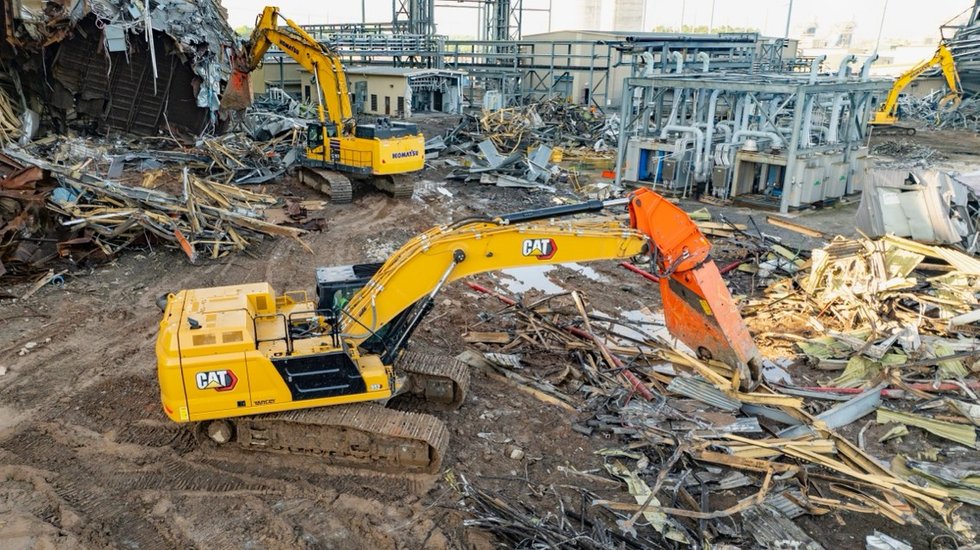
The planning layer in modern demolition has become every bit as important as the execution. The reason is straightforward: the consequences of being surprised in the field are higher than they used to be. Plants are more congested. Schedules are tighter. Capital projects downstream of a demolition scope cannot absorb slip time. And the structures being removed are often older than the drawings that are supposed to describe them, if drawings exist at all.
For plant operators and management, understanding how a serious demolition contractor builds a plan before the work begins is often the difference between a scope that runs smoothly and one that generates surprises nobody wanted.
The problem with old drawings
Any plant professional who has been through a capital project knows the feeling of pulling drawings that were last updated two or three decades ago. Modifications over the years went in without drawing updates. Fireproofing was added or removed. Supports were reinforced. Piping was rerouted. The drawings in the file cabinet describe a structure that no longer exists in the form shown.
For a demolition contractor, this is more than an inconvenience. It is a safety issue. Cuts planned against outdated drawings can encounter unexpected loads. Pick sequences built on assumed geometries can hit surprises that change the entire approach. A structural member that looks decorative on paper may turn out to be the only thing keeping a larger assembly in compression.
The modern response to this problem is to treat the pre-job survey as a data collection exercise, not a walk-around. Contractors with real engineering capability show up with tools that can capture the condition of a structure as it actually exists in the field, not as it exists in the archive.
Drones and laser scanning have changed the first day of the job
Drone surveys have moved from novelty to standard practice for structures that are too congested, too deteriorated, or too hazardous to walk. A drone equipped with high-resolution cameras and LiDAR can map a structure in hours, producing a dataset that engineers can work from with far greater confidence than a hand-sketched site survey.
The value shows up in specific situations that plant operators will recognize. A structure that sits on top of another structure, where climbing access is difficult and the lower building has to remain untouched. A deteriorated facility where walking the upper levels presents risks that outweigh the information gained. A congested process area where the target equipment is buried in a lattice of surrounding infrastructure that needs to be documented before planning can begin. In all of these cases, the drone flight produces a model that the engineering team can reference throughout the project, updated as conditions change.
Laser scanning extends this further. A point-cloud scan creates a three-dimensional representation of the structure accurate to millimeters, which can be compared against the original drawings to identify deviations and used to generate a reverse-engineered model when drawings are missing or unreliable. That model becomes the reference for pick planning, load calculations, and sequencing.
It is worth noting that drone use inside a refinery or chemical plant is not automatic. Most plants require a specific permit, FAA compliance, and a licensed operator. A contractor who treats drone work casually will not be allowed to fly. A contractor who has the credentials, procedures, and relationships already established arrives ready to use the tool on day one.
Engineering that supports the field
There is a long-standing tension in industrial services between the work that happens on a laptop and the work that happens on the ground. The best demolition contractors have figured out how to connect the two.
In-house or closely integrated engineering resources mean that when a field condition changes, the response does not require a three-week handoff to a consultant. A pick that was going to be made one way gets re-analyzed the same day. A structural assessment that was based on assumed material properties gets updated when the crew confirms actual conditions. A load path that was supposed to be redundant turns out not to be, and the sequence changes before the cut happens, not after.
This is the quiet part of modern demolition. It rarely shows up on a project photo. But it is the reason certain contractors can be trusted with work that others cannot.
Progressive collapse modeling and why it matters
One of the more significant engineering tools in demolition planning is progressive collapse analysis, often executed using finite element methods. The technique models how a structure will behave as material is removed, identifying the points at which controlled failures become predictable and the points at which they become risky.
For a plant operator, the practical value of this analysis is that it removes guesswork from the most consequential decisions on the project. When a contractor proposes to section a structure in a particular sequence, the progressive collapse model shows why that sequence is stable at each stage, where the critical members are, and what happens if a cut is made in the wrong order. It provides a documented basis for the plan that can be reviewed by the plant’s own engineering staff, which matters both for approval and for confidence in execution.
This type of analysis used to be reserved for the largest and most technically complex projects. It has become more accessible, and serious contractors now apply it to routine scopes where the downside of a wrong assumption is high enough to justify the effort.
Visual models for stakeholder alignment
One of the less technical but most practical uses of modeling technology is communication. Industrial demolition inside a live plant involves stakeholders who do not always speak the same language. Operations thinks in terms of process safety and unit availability. Capital projects thinks in terms of schedules and handoffs. Safety thinks in terms of permits, controls, and exposures. Engineering thinks in terms of loads and sequences.
Bringing those groups together around a single plan used to require hours of meetings and long-form written procedures that not everyone read. Three-dimensional visualizations, sometimes casually referred to as “cartoons” by the people who build them, collapse that alignment process. Everyone looks at the same model. The sequence is shown step by step. The protective measures are visible in context. Questions get asked and answered in front of the visual rather than in a separate email thread two weeks later.
This is not a gimmick. It is a tool that reduces the number of misunderstandings between groups who all have legitimate authority over the work. For plant management, a contractor who shows up with a clear visual plan and uses it to align stakeholders is demonstrating something important about how they think about the project.
Field instruments the plant may not see
Beyond planning tools, serious demolition contractors now carry a range of field instruments that were rare on a jobsite a generation ago. Portable gas monitoring equipment allows the crew to do its own atmospheric sensing in coordination with the plant’s fixed systems. Radioactive screening equipment, particularly on refinery tube work and any material exposed to high-heat service over long operating periods, allows the contractor to check materials for above-background readings before they leave the site. That one capability prevents a scenario that every plant wants to avoid: a truckload of scrap metal rejected at the receiving yard and sent back to the plant because the material was not pre-screened.
Wearable monitoring technology has also become more common on extreme-condition jobsites, tracking heart rate and core temperature to identify workers who are approaching dangerous exposure levels before symptoms appear. Combined with cooling stations, shift time adjustments, and structured rest rotations, these tools have become part of the standard toolkit for working in the Gulf Coast during summer or in northern plants during winter extremes.
None of this replaces the fundamentals of good demolition work. But it layers a margin of safety and predictability onto the fundamentals that was not available a generation ago.
What this means for plant decision-makers
The short version is this: the demolition contractor a plant selects is increasingly a choice about planning capability, not just execution capability. The ability to survey structures accurately before touching them, to model their behavior under controlled removal, to align stakeholders around a shared visual plan, and to bring independent monitoring tools into the field has become the difference between a scope that runs on schedule and one that generates repeated surprises.
None of this shows up in a lump-sum bid number. It shows up in the quality of the plan the contractor submits, the clarity of the visualizations they bring to pre-job meetings, and the confidence with which their field supervisors answer questions about how they are going to handle the unknowns.
For capital projects managers and operations leaders evaluating demolition contractors, the right questions are not just about crew size and equipment roster. They are about how the contractor will see the work before it begins, and how they will use that visibility to reduce the risk that the plant will have to absorb in the field.
For more information on demolition planning, engineering, and field technology capabilities, visit www.jacksondemolition.com.