
NOTE: The sponsor of this content may contact you with more information on this topic. Click here to opt-out from sharing your email address with this sponsor. (This link will not unsubscribe you from any other BIC email list).
Industrial and energy operators know the challenge well. A turnaround may require an inspection contractor, scaffolding crew, coatings team, and safety provider, often resulting in four vendors, four schedules, multiple purchase orders, and several points of accountability. Every handoff creates another opportunity for information to be delayed, priorities to become misaligned, and risk to enter the project.
PK Companies
PK Companies
PK Companies built its business around closing those gaps. This year, the company took its most significant step yet toward delivering that model at a national scale.
Founded 29 years ago as a regional contractor, PK Companies has grown into a national asset reliability service provider, logging more than four million man-hours annually across refineries, chemical plants, power facilities, data centers, manufacturing sites, and offshore operations. Its teams currently support roughly 230 active projects throughout all 50 states and international locations.
An asset reliability service provider does more than inspect equipment or complete an individual maintenance scope. It helps owners understand asset condition, prioritize risk, plan work, execute repairs, protect the workforce, and maintain reliable records throughout the asset's operating life.
For PK Companies, that means connecting inspection, engineering, industrial services, safety support, and digital technology within one organization. The goal is to help clients manage the full asset lifecycle, from fabrication, construction, and commissioning through ongoing operations, maintenance, turnarounds, repair, and long-term integrity planning.
A new name and a new look
In 2026, PK Companies united two of its inspection businesses, PK Technology & Inspection and the recently acquired Pro-Surve Technical Services, under a single new brand: PK Technical & Inspection.
The move followed PK's acquisition of Pro-Surve, a Houston-based inspection and asset integrity firm with more than a decade of experience serving oil and gas, aerospace, manufacturing, and other industrial clients across the country.
The combination represents more than a new name and logo. It brings together Pro-Surve's technical depth in nondestructive examination, API inspection, quality assurance, and asset integrity programs with PK Technology & Inspection's field-tested processes, engineering capabilities, and proprietary technology.
Together, these capabilities create a national inspection organization with the personnel, systems, and technical resources to support major turnarounds, multi-site programs, capital projects, and ongoing maintenance work. Clients gain one inspection partner with consistent standards, centralized reporting, and the ability to scale across facilities without rebuilding the process at every location.
“Bringing Pro-Surve and PK Technology & Inspection together under one name reflects what our clients have been asking for,” said Stewart Records, CEO of PK Companies. “We are a single inspection partner they can rely on everywhere they operate, without sacrificing the personal, responsive service that got us here.”
The PK Technical & Inspection rebrand was part of a broader company-wide evolution. In July 2026, PK Companies introduced updated branding and newly launched websites for PK Technical & Inspection, PK Industrial, and PK Safety.
The timing was deliberate. As PK's capabilities and geographic reach have expanded, the company wanted its brand to reflect what the organization has become: a connected national provider rather than a collection of separately positioned businesses.
“This wasn't just a new look for one division. It was a chance to show the market what PK has actually become: one company with the scale to take on major projects and the craftsmanship to still get the details right,” Records said.
One platform, three coordinated disciplines
PK Companies operates through three coordinated service divisions, each supporting a critical part of asset reliability.
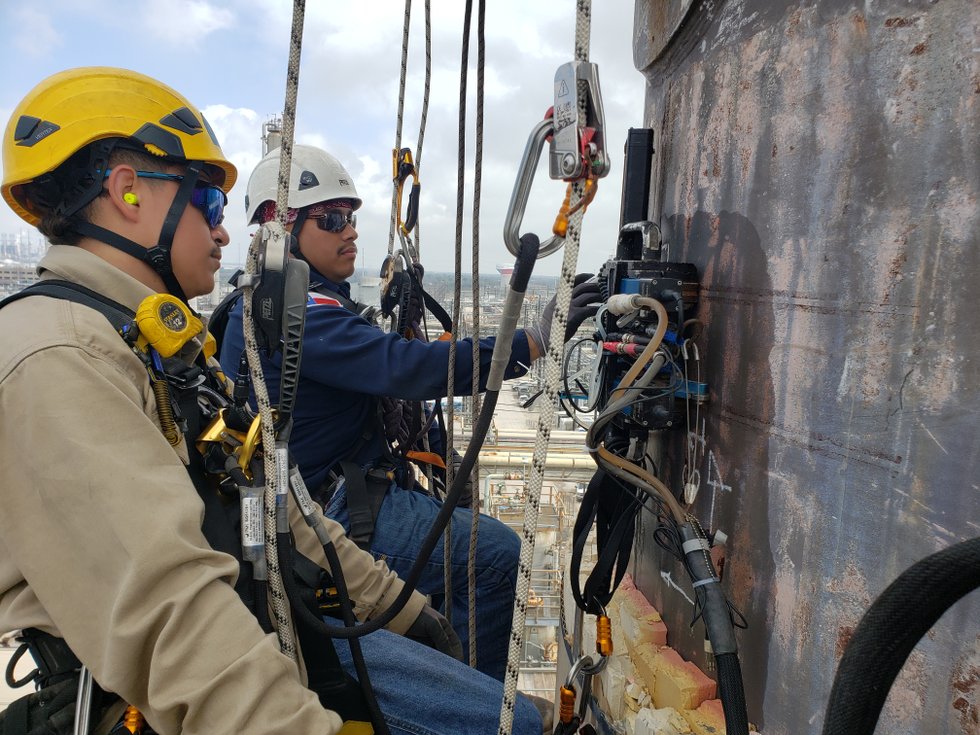
PK Technical & Inspection helps clients identify asset condition, understand risk, meet regulatory requirements, and make informed maintenance decisions. Its capabilities include nondestructive examination, API inspection, engineering, quality assurance and quality control, mechanical integrity programs, vendor surveillance, rope access, data management, and specialized inspection support.
PK Industrial performs the soft-craft and protective work needed to maintain and extend asset life. Its services include scaffolding, insulation, protective coatings and linings, passive fireproofing, flooring, abatement, and other field and shop-applied solutions. These capabilities allow PK to move directly from identifying a problem to providing access, removing affected materials, completing surface preparation, applying the appropriate protective system, and supporting the asset's return to service.
PK Safety provides the personnel, equipment, planning, and technology needed to protect people while complex work is performed. Services include safety attendants, technical rescue teams, onsite safety professionals, medical support, rental equipment, and digital confined-space monitoring. Much of that work begins before the first tool is picked up through rescue planning, equipment staging, hazard assessment, training, and workforce preparation.
Individually, each division competes with specialized providers in its field. Together, they give clients something more difficult to find: coordinated support across the full lifecycle of an asset, with fewer gaps between identifying an issue, planning the response, executing the work, and protecting the people involved.
Connecting the asset lifecycle through technology
Technology serves as the connective tissue between PK's field capabilities.
Through its proprietary intelliSPEC platform, PK can help clients replace disconnected spreadsheets, paper reports, photographs, and static inspection files with a centralized digital record of asset condition and work history. Field personnel can capture inspection data, photographs, videos, measurements, and supporting documentation at the point of work, including in environments with limited connectivity.
That information can then be organized into digital reports, dashboards, performance indicators, and prioritized work lists. Instead of waiting for separate reports to move between contractors and departments, authorized stakeholders can gain near-real-time visibility into findings, status, trends, and areas requiring attention.
For integrity and maintenance teams, this supports more informed decision-making. Inspection results can be evaluated alongside historical asset data to help determine which items require immediate action, which can be monitored, and where maintenance spending will have the greatest effect on reliability.
The same visibility can improve coordination between departments. Inspectors, engineers, planners, maintenance teams, safety professionals, and leadership can work from a more consistent set of information rather than relying on separate versions of the asset's condition or project status.
Digital reporting also creates a more complete record throughout the asset lifecycle. Data gathered during fabrication, construction, commissioning, routine inspection, maintenance, repair, and future reinspections can become part of an ongoing integrity history rather than being stored as isolated project files.
Supporting carbon steel throughout its service life
The integrated model is especially valuable for carbon steel management, where corrosion, coating failure, damaged insulation systems, environmental exposure, and aging infrastructure can create both reliability and safety concerns.
Effective carbon steel management is not a single inspection or coating project. It is an ongoing process that includes establishing baseline condition, identifying corrosion mechanisms, monitoring deterioration, prioritizing risk, planning access, removing insulation or failed coatings, completing repairs, applying protective systems, and documenting the results for future maintenance decisions.
PK's divisions can support that process from beginning to end.
PK Technical & Inspection can assess asset condition through visual inspection, nondestructive examination, thickness monitoring, mechanical integrity programs, and engineering support. PK Industrial can provide access, remove and replace insulation, prepare surfaces, complete repairs within its scope, and apply coatings or linings designed to protect the asset. PK Safety can develop the safety and rescue plans, supply trained personnel, and monitor the work environment while those activities take place.
The resulting inspection and execution data can be captured digitally to create a traceable record of what was found, what action was taken, and when the asset should be evaluated again.
This coordinated approach helps clients move from reactive repairs toward planned, data-supported asset management. It can also help reduce repeat mobilizations, avoid unnecessary work, and identify opportunities to address related scopes while access and safety systems are already in place.
Right-sized for the work
PK occupies a deliberate middle ground in the industrial services market. The company is large enough to support major turnarounds and multi-site programs across all 50 states, with more than 1,400 employees, capital backing, and the infrastructure to mobilize quickly. At the same time, it remains structured to respond without the layers of bureaucracy that can slow larger national organizations.
PK also offers the depth and consistency that smaller regional contractors may struggle to provide across larger or more complex scopes.
That balance is reflected in how the company wins and retains business. A significant percentage of PK's work is repeat and maintenance-based, built on long-term relationships rather than one-time projects. That record reflects a culture centered on responsiveness, ownership, safety, craftsmanship, and follow-through as much as technical capability.
PK's leadership also recognizes that the market's perception of the company has not always kept pace with its growth. Some organizations may still view PK primarily as a fireproofing or scaffolding contractor. In practice, it has become a diversified asset reliability platform delivering inspection, engineering, industrial services, safety support, and proprietary technology through one organization.
Closing that gap between perception and reality is a central part of the company's story today.
What it means for operators
For plant managers, integrity engineers, maintenance leaders, and procurement teams, the benefit of PK's integrated model is practical: fewer contractors to coordinate, fewer handoffs, clearer accountability, improved access to project information, and a more direct path from inspection finding to completed work.
A typical corrosion-under-insulation scope demonstrates how the model can work.
An inspection team identifies potential deterioration on a critical carbon steel line. Under a traditional model, the client may need to issue separate requests to a scaffolding contractor, insulation company, NDE provider, coatings contractor, and safety vendor. Each company must be scheduled, onboarded, mobilized, and given the necessary information before its part of the work can begin.
Under PK's model, inspection, access, insulation removal, safety planning, surface preparation, protective coatings, insulation replacement, and digital documentation can be coordinated within one organization. The teams can share information earlier, sequence the work around the client's schedule, and reduce delays between discovering the condition and addressing it.
The benefits extend beyond convenience. Fewer transitions can reduce the chance of inspection findings being misunderstood, repair priorities being delayed, or important information being lost between vendors. Coordinated planning can also limit redundant site visits, duplicated onboarding, repeated equipment mobilizations, and schedule conflicts.
A second example can be seen in a facility-wide carbon steel maintenance program. Inspection data may identify multiple areas of coating breakdown or corrosion across piping, vessels, structural steel, and insulated systems. Instead of treating each finding as a separate emergency project, PK can help the client organize the data by condition and risk, build a prioritized work plan, coordinate access and safety requirements, execute the selected scopes, and document the completed work within the asset's digital history.
This gives owners greater visibility into what requires immediate attention, what can be bundled into an upcoming outage, and what should continue to be monitored. It also allows maintenance budgets and workforce resources to be directed toward the highest-value work.
Safety can improve through the same coordination. When inspection, industrial, and safety teams plan together, access requirements, confined-space conditions, rescue needs, equipment staging, and work sequencing can be considered before crews mobilize. Risks are addressed as part of the overall execution plan rather than added after the scope has already been developed.
Execution efficiency improves because the people responsible for identifying conditions, planning the work, providing access, protecting the workforce, and completing the scope are working toward the same schedule and outcome. Procurement teams manage fewer vendor relationships and purchase orders. Project leaders spend less time transferring information between contractors. Operations teams gain clearer visibility into progress and outstanding work.
“Clients don't want to manage four vendors and hope the handoffs go smoothly. They want one team that understands the asset, coordinates the work, and owns the outcome. That's what we built PK to be,” Records said.
The integration of Pro-Surve, the introduction of PK Technical & Inspection, and the company-wide rebrand are all part of the same strategy: provide broader national capabilities while preserving the responsiveness, accountability, and craftsmanship that built PK's reputation.
For clients, the result is a more connected approach to asset reliability: one team helping manage the asset, the data, the work, and the safety plan throughout the full lifecycle.
Learn more about PK Companies' integrated inspection, industrial, safety, and asset reliability solutions at www.pksti.com.