
There is a list Kate Lightfoot keeps in her head. Five roles. Five times she walked into a job no woman had held before her.
She does not lead with it or define herself by it, but she does not pretend it is not there, because she understands what it means for the people watching.
"It’s become normal for me to be that example setter," said Lightfoot, who serves as Baton Rouge Integrated Complex Manager for ExxonMobil, overseeing one of the largest integrated refining and petrochemical operations in the U.S. "People don’t have to constrain themselves because of the way they see other people perform a role. I’ve never performed a role like the person I followed, because I have different personal boundaries than the people I follow."
Nearly 4,000 employees and contractors work within the complex fence lines on any given day. What Lightfoot built over more than two decades to reach this role is less a story about gender than about discipline.
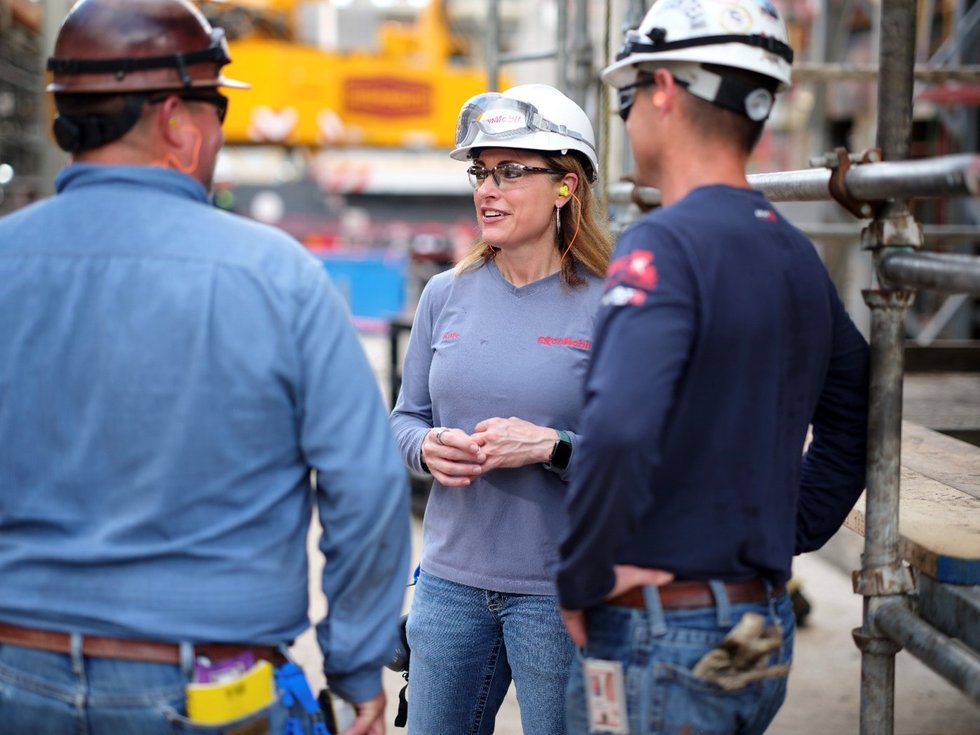
Kate Lightfoot: Building on a foundation of firsts
Kate on one of her weekly field walks, her leadership non-negotiable.
From Arkansas to Baytown
Lightfoot grew up in Arkansas, the daughter of an English teacher. A friend’s suggestion during her freshman year at the University of Arkansas pointed her toward chemical engineering, and she graduated with both a degree and a direction. She joined ExxonMobil at the Baytown Chemical Plant, later earned an MBA from the University of Houston-Clear Lake and moved into a financial analyst role.
"Most of what I learned in those early years wasn’t really chemical engineering in nature," she said. "It was more about work processes, improvement processes, with a lot of interface with operations. Those are still my strongest skills today."
The operational foundation
For the better part of a decade, Lightfoot built her career inside Baytown Chemical Plant, cycling through technical and operational roles before moving to the Baytown Olefins Plant in 2011. "I had to figure out what my process was for getting to know the people, the organization, the way things work, the technology, while expanding my span of control at the same time," she said. "That’s where I gained confidence in my ability to do that."
She returned to Baytown Chemical Plant in 2017 as process manager and was named site manager the following year, the first woman in the role. The timing carried an irony she has not forgotten. A decade earlier, in that same office, she had asked her supervisor to take her name off whatever development list he was managing. She told him she had young children —then ages four and six — and it was too much. He refused.
"Funny enough, I returned to the exact office and into the exact role I was speaking to 10 years earlier with a brand new baby," she said. "For me it was about demonstrating for myself and others that I could do both."
Proving that became the foundation for what followed. ExxonMobil named her Baton Rouge Integrated Complex Manager.
Running the Baton Rouge Integrated Complex

Kate Lightfoot: Building on a foundation of firsts
Kate and her son Gavin, 9, at ExxonMobil’s STEM Saturday, supporting hands-on STEM education for Baton Rouge students.
She is up at 4 a.m. most days. That hour belongs to her alone. She goes to the gym before the calendar fills. It is daily discipline and, she will tell you, the thing that makes everything else sustainable.
"It’s the only time of day that no one has scheduled or needs me," she said. "It’s important for me to prove to myself every day that I come first. If I don’t take care of myself, I can’t show up for all the other responsibilities I’ve taken on."
No two days look alike from there. She estimates four to five hours per week in the field, holding the kind of direct conversations with frontline workers that rarely happen at her level. She holds weekly open forums with employee groups, fielding questions without hedging.
"Most often when I leave those meetings, people say things like, in my 30 years I’ve never had anyone at your level speak that directly to me," she said. "But people talk. The message gets out."
Consolidating refining and petrochemical leadership under a single manager has produced real advantages, with clarity of message being the most immediate. A single point of authority removes that drag and gives the organization room to find where integration creates value.
It also produces a more agile operation, capable of shifting production in response to feedstocks and market signals. None of that holds without the reliability that comes from a workforce holding its standards daily, which is why safety and operational performance at Baton Rouge have always been the same conversation.
Safety as a personal standard

Kate Lightfoot: Building on a foundation of firsts
Kate addresses high school students at ExxonMobil’s annual Introduce a Girl to Engineering Day, an event designed connect young women with female leaders.
Lightfoot does not treat safety as a compliance posture. She treats it as a personal code, one that has to be visible and consistent without exception.
"You have to have unwavering high standards," she said. "You can never show a crack in that armor. You have to know the standards or be knowledgeable enough to ask about them, and you have to have a reputation of enforcing them all the time."
Her field presence serves that purpose directly. The experience she returns to most when describing high-stakes leadership is Hurricane Harvey, when she served as incident commander at Baytown on nights. The facility flooded, operations shut down and no relief was coming for 48 hours.
"That taught me a lot about how calm I become under pressure," she said. "I just am calm under pressure. It’s one of the you’ve got it or you don’t, but it instilled confidence in me that I had a differentiating capability there."
Talent, contractors and the next generation
When the conversation turns to where the sector is most at risk, Lightfoot does not reach for feedstock prices or global competition. She points to the narrowing pipeline of workers who understand at a foundational level how industrial equipment is built, maintained and run.
"There is no replacement for the human’s ability to understand mechanically what is going on," she said. "That needs to start in middle school. We’re going to have to partner more with secondary education to develop the curriculum."
At Baton Rouge, the workforce runs roughly half employees and half contractors. Many of ExxonMobil’s direct hires came through contractor crews first, working inside the fence line long enough to understand the culture.
"People enter our facility on a contractor crew, they get to know us and we get to know them, and they become interested in hiring on with ExxonMobil," she said. "For the state of Louisiana, that’s really positive."
Retention comes down to whether the culture is worth staying for. Which brings Lightfoot to a word she stopped using years ago.
The word she dropped
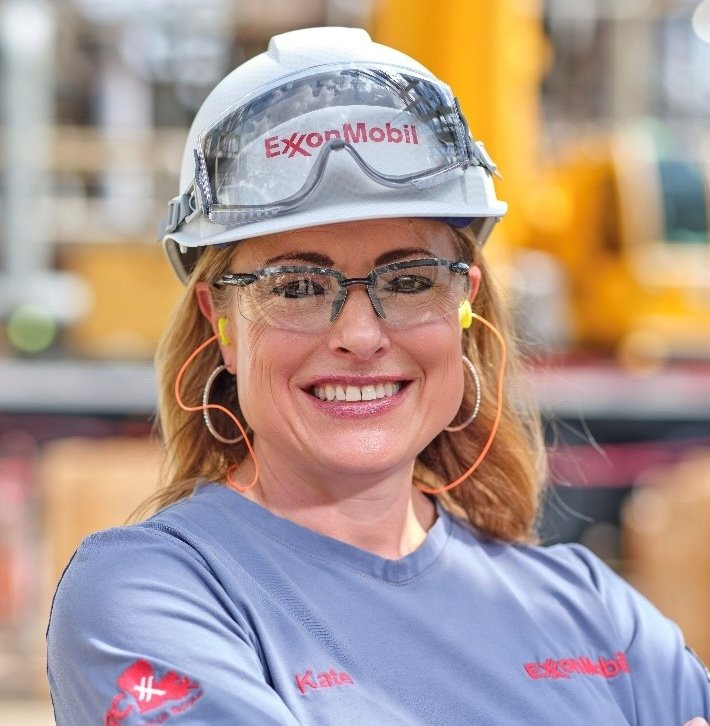
Kate Lightfoot: Building on a foundation of firsts
Kate Lightfoot, Baton Rouge Integrated Complex Manager, ExxonMobil
There was no announcement. She simply stopped apologizing for things she had no reason to be sorry about and noticed how often the women around her were still doing it.
"Why are you sorry for taking your kids to the doctor?" she said. "If that’s what you need to do, then that’s what you need to go do."
She coaches other women toward the same standard: name what you need and stop treating your own life as something requiring apology.
The guidance she gives young women runs the same direction. Go deeper on the technology than the task demands. Ask questions past the point of comfort. The people who build lasting credibility understand what they are working with at a foundational level.
"I wish I had taken more time and asked more questions for that deeper level of understanding very early," she said.
On how the industry presents itself publicly, she is equally plain. Stop leading with process. Lead with products.
"We need to continue to help people understand that everything they’re sitting on, laying on, touching, driving, utilizing electronically is driven by the petrochemical industry," she said. "Their lives would look dramatically different without it. It would be unrecognizable."
For an industry that turns raw materials into the fabric of modern life every day, it is a remarkably underused argument. Kate Lightfoot is not in the habit of leaving strong arguments unused.
For more information, visit exxonmobil.com.