
For decades, scaffold planning relied on 2D drawings, site walks, manual estimating and field experience.
Those methods built an industry, but they also introduced uncertainty. Today, digital technologies are changing that equation. Brock Pulse brings together 3D modeling, laser scanning, digital twins, drone technology and integrated project data to help customers make better decisions before work begins. The result is greater schedule certainty, improved safety, better labor utilization and more predictable project costs.

Enrique "EZ" Zabala, Director of Technical Services & Innovation, Brock Group
Delivering measurable customer value
3D modeling uses a suite of software tools that include computer-aided design (CAD) programs for scaffold design, software for architectural design, MEP and structural engineering and building information modeling (BIM) software to simulate construction and identify and resolve clashes. Other software tools also integrate within this ecosystem. Typical ones include scaffold management systems that track scaffold components, field management software tools that track labor and quality, ERP systems and dashboards and reporting tools that offer insightful analytics and actionable intelligence.
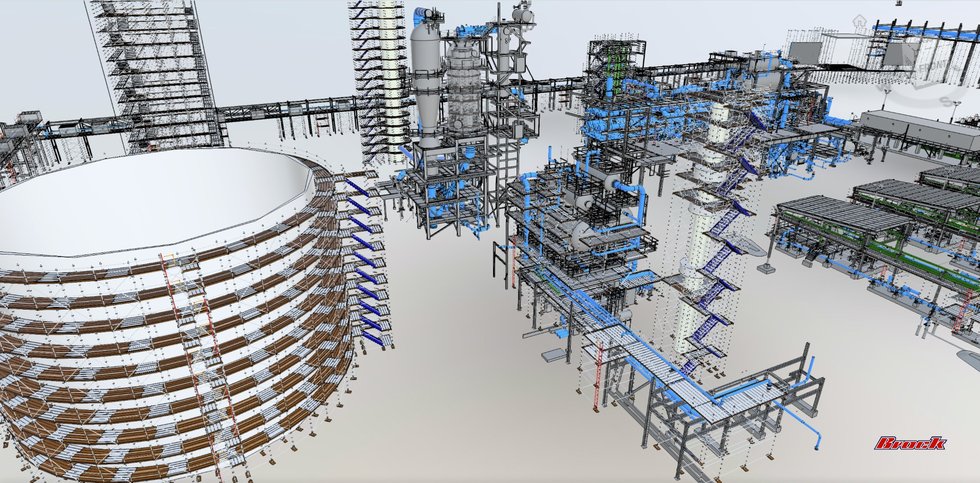
3D models provide a unified view of scaffold and construction data to accelerate planning and turnaround execution.
With a digital twin that reflects actual, as-built field conditions, project teams can validate plans before construction begins. 3D modeling changes the conversation changes from "How do we solve this problem in the field?" to "How do we prevent the problem altogether?"
By creating a cohesive digital ecosystem, soft craft leaders create a 360-degree view of a project that delivers five key benefits:
1. Greater schedule certainty. Schedules drive turnarounds and capital projects. Unexpected scaffold modifications or delayed work packages can ripple across an entire project. By identifying access constraints and constructability issues early, teams reduce field changes and execute work packages with greater confidence. Better planning leads to fewer surprises, smoother execution and more predictable schedules.
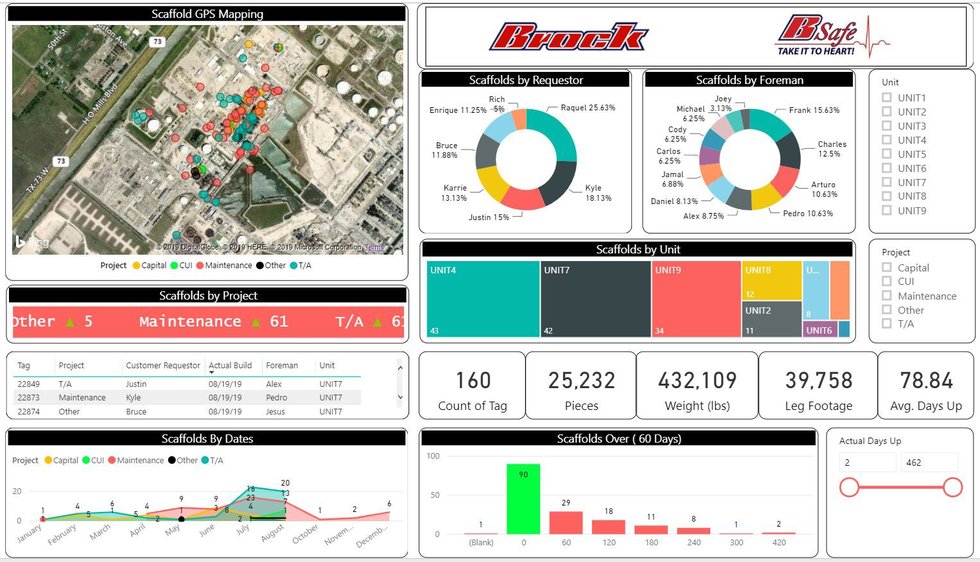
SMS dashboards, when shared with the owners, EPCs, construction teams, trades and other stakeholders, promote transparency and collaborative decision-making. Note: Dashboard for illustrative purposes only.
2. Better cost predictability. Accurate planning produces accurate material forecasts. Rather than estimating scaffold requirements with large contingencies, software generates material quantities directly from the 3D model. Customers gain greater confidence in budgeting, reduce excess inventory, minimize rental requirements and improve cost control. 3. Smarter workforce planning. Material forecasting and labor planning go hand in hand. When project teams know exactly what will be built and when, they can deploy skilled craft labor more efficiently. As a result, productivity improves, which in turn helps contractors make the most of today's increasingly competitive labor market.
4. Improved collaboration. Operations, maintenance, engineering, construction, scaffolding teams and subcontractors can review a single model, discuss alternatives and agree on the best approach before work begins. When everyone works from the same information, coordination improves and misunderstandings decrease.
5. Enhanced safety. Visual work plans allow crews to better understand scaffold erection and dismantling sequences. Potential hazards can be identified during planning instead of execution, which helps reduce exposure and supports safer, less congested work areas.
Planning that pays for itself
On a recent project, the contractor anticipated numerous field modifications and planned to maintain a three-person scaffold crew on standby throughout a three-month project. Fortunately, Brock was able to develop a 3D model. By resolving nearly every issue during planning, only one minor modification was required after erection. Rather than consuming more than 1,400 standby labor hours, the project required less than 25 labor hours of field modification1. In addition, better coordination improved productivity for every contractor working on the project.
On a large LNG project, the customer brought in Brock to provide a single source for scaffold management and to accelerate schedules. A software-driven scaffold management system (SMS) played a key role, as it provided data on inventory status, scaffold utilization and age, locations, ownership, estimated hours and cost. Through data-driven management and other efficiencies, Brock doubled efficiencies, eliminated approximately 1.1 million unnecessary pieces of scaffold, and cut overspend in half1.
3D modeling drove further efficiencies by preventing unnecessary rework. The software also generated a component list so scaffolders could pre-kit material and deliver it to the required locations. On the back end, SMS pulled in information from design, ERP and scaffold tracking software, refreshing data three times a day. Graphical dashboards displayed metrics and analytics, and the EPC had direct access for full transparency and collaborative decision-making.
3D modeling has repeatedly shown, across Brock projects, that planned work tends to outperform unplanned work. By using 3D modeling, scaffolders can also optimize the advanced work packaging (AWP) methodology that breaks down complex projects into smaller, more manageable pieces and then pre-kit materials for each of those scaffolds. Mobilization proceeds faster, as does turnaround planning.
Further, scaffolders can plan the dismantle so that the materials can be redeployed according to the AWP, mitigating the need to rent additional scaffolds.
Beyond scaffolding
While scaffold planning has become an early beneficiary of digital innovation, the same principles apply across soft craft services. Painting, insulation, fireproofing, asbestos abatement, asset management and other industrial services all benefit from improved visualization, better coordination, accurate forecasting and stronger planning.
The vision behind Brock Pulse is to combine decades of field experience with digital innovation to deliver better project outcomes. The technology behind these digital innovations will remain invisible to EPCs and customers, but the results will be front and center: when work begins, everyone knows that they are already working from the best possible plan.
For more information, visit brockgroup.com.
1The results and benefits described in this article are illustrative, specific to the referenced projects and not a guarantee of future performance; actual results will vary depending on project scope, conditions and other factors.