
NOTE: The sponsor of this content may contact you with more information on this topic. Click here to opt out of sharing your email address with this sponsor. (This link will not unsubscribe you from any other BIC email list.)
A freshly blasted steel surface can look perfect to the naked eye.
The profile is sharp. The crew is ready. Environmental conditions are within spec.
And yet, months later, the coating fails.
Blistering appears around welds. Rust creeps beneath the coating system. Asset owners face unplanned shutdowns, costly maintenance cycles and frustrating forensic investigations.
In many cases, the problem started before the coating was ever applied: invisible surface contamination.
Residual salts — particularly chlorides, sulfates and nitrates — remain one of the leading contributors to premature coating failure. These contaminants create corrosion cells beneath coatings, accelerate osmotic blistering and compromise adhesion over time.
The challenge is that many traditional preparation methods still focus primarily on visible cleanliness.
A surface can visually pass inspection while still carrying the chemical conditions necessary for future failure.
Why surface preparation is evolving
Corrosion Innovations
Owners today expect longer service life, fewer shutdowns and lower lifecycle maintenance costs. Contractors, meanwhile, are under pressure to reduce rework, avoid delays and improve first-pass acceptance rates.
That shift is changing how industrial facilities approach surface preparation.
The industry is recognizing that abrasive blasting alone may not fully remove embedded salts concentrated deep within the substrate profile. Repeated water washing cycles can help, but they also increase labor, water usage and project costs.
Modern liquid surface preparation technologies are helping solve that problem.
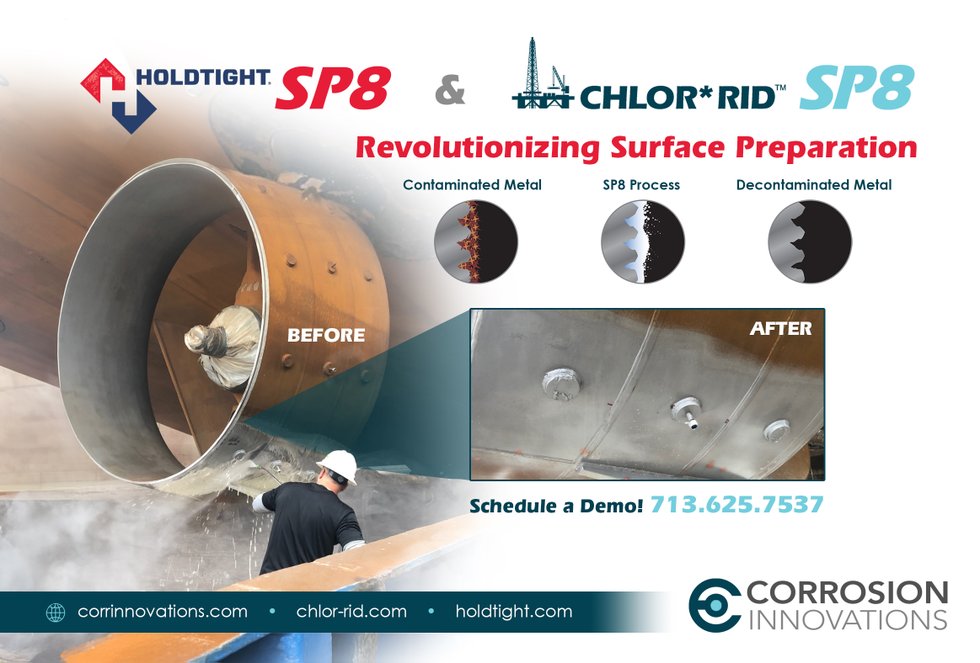
Corrosion Innovations has built a comprehensive portfolio designed to help contractors and asset owners address contamination more strategically through technologies including Chlor*Rid™, Corr-Ze™ and HoldTight®.
Acidic products are primarily designed for aggressive salt removal and decontamination, while alkaline products are typically used for passivation, flash rust prevention and extending the available coating window.
Corrosion Innovations’ lineup includes acidic decontamination products like Chlor*Rid™,Chlor*Rid SP8 Gel™ and Corr-Ze™ 200 Gel, alongside alkaline passivators and flash rust prevention technologies such as HoldTight® 102, HoldTight® HT365™, Chlor*Rid Hold*Blast™ and Chlor*Rid SP1 Rinse.
The cost of flash rust and rework
Few issues disrupt productivity more than flash rust.
A surface that appeared ready for coating in the morning can develop visible rusting before the shift ends, particularly in humid or marine environments.
Historically, the solution often meant re-blasting — adding labor costs, abrasive consumption, production delays and schedule pressure.
A recent KTA-Tator case study, “Removing Flash Rust Without Re-Blasting,” highlighted the use of the Chlor*Rid SP8 system to remove flash rust without requiring full re-blasting. The process allows contractors to restore prepared surfaces while minimizing downtime and avoiding unnecessary rework.
Long-term performance is the real metric
Owners increasingly care less about how a surface looks on turnover day and more about how the coating system performs years later.
One notable five-year exposure study involving HoldTight® 102 evaluated coating performance in harsh coastal conditions. According to published results, treated panels demonstrated equal or improved adhesion and significantly reduced coating degradation compared to untreated panels. The study also suggested coating life extension in the range of 25% to 50%.
Surface preparation is no longer simply a procedural step.
It is one of the biggest drivers of long-term coating performance.
For more information about liquid surface preparation technologies, ion-specific testing, and corrosion prevention strategies, visit Corrosion Innovations to book a demo or download Corrosion Innovations’ white paper on advanced surface preparation solutions.