
NOTE: The sponsor of this content may contact you with more information on this topic. Click here to opt-out from sharing your email address with this sponsor. (This link will not unsubscribe you from any other BIC email list).
A disconnect between passive fire protection material selection methods and modern multi-phase hazard scenarios threatens petrochemical, LNG, and other critical processing and handling facilities. Fireproofing technical expert Stuart Bradbury introduces the gap, explains the problem it causes, and shares how manufacturers can help close it.

Q: What is the gap, and why is it a problem?
A: The gap is that current industry testing evaluates cryogenic protection and fire protection separately, even though real incidents often involve both hazards in sequence. Engineers, and by extension, material producers, typically calculate cryogenic spill protection (CSP) and fireproofing thickness independently and select the most conservative one, assuming the material will remain intact and fully adhered after a cryogenic release and still perform during a subsequent fire.
The problem is that this assumption isn’t always supported by evidence. Cryogenic exposure can cause cracking, debonding, or other defects in products. Some materials are more susceptible than others, meaning their fire performance after a cryogenic event is often implied rather than proven. This creates a risk that materials may not perform as expected in actual multi‑phase hazard scenarios.
Q: A multi-phase risk involving cryogenic exposure followed by fire isn’t new. But why is it more acute today?
A: In short, condensed facility layouts plus more severe hazard geometry combined with incomplete multi‑phase testing may lead to a more acute risk today.
Modern LNG and petrochemical facilities are far more compact than older designs. Liquefaction trains that once occupied large footprints with generous spill runoffs are now condensed into tight modules. This increases confinement and congestion conditions that can intensify the consequences of a cryogenic release.
In a compact layout, a cryogenic spill can pool or rapidly boil off, affecting multiple adjacent structures. If ignition occurs, the resulting overpressure and fire can escalate quickly because equipment is so closely spaced.
Legacy validation methods have not kept pace with newer standards. Earlier operator testing relied on full‑immersion cryogenic exposure of steel specimens protected with single or duplex system approaches, followed by fire testing. In contrast, newer standards such as ISO 20088 do not fully address post‑fire performance or sequential hazards. As a result, materials may be qualified for cryogenic exposure and fire individually, but not for the real‑world possibility of cryogenic shock followed by fire.
This raises unresolved questions: Does the older sequential method become obsolete? Should it complement the ISO approach? How should discrepancies in required protection thickness be handled when comparing the two methods directly, noting potential differences in release conditions and the severity of such on specific product technologies?
Q: How have material manufacturers met this moment?
A: Manufacturers have responded by developing products that are increasingly multifunctional, but the testing approach hasn’t evolved at the same pace. Today’s PFP systems are expected to provide cryogenic spill protection, fire protection, and explosion resistance, to name a few, often within a single product. While manufacturers can evaluate materials for each hazard, testing and assessment are still performed in isolation. This approach may not sufficiently demonstrate whether a material can survive an initial cryogenic event, withstand repeated exposures, or maintain performance through a subsequent explosion or fire without repair or replacement.
Q: Recent testing from Carboline helps close these gaps. Can you summarize what you found?
A: We conducted third‑party testing on Pyrocrete 341 to evaluate its performance in a true multi‑phase hazard sequence, using a combination of established test standards. Pyrocrete 341 is a hybrid cementitious system designed to maintain insulating efficiency at both cryogenic and elevated temperatures.
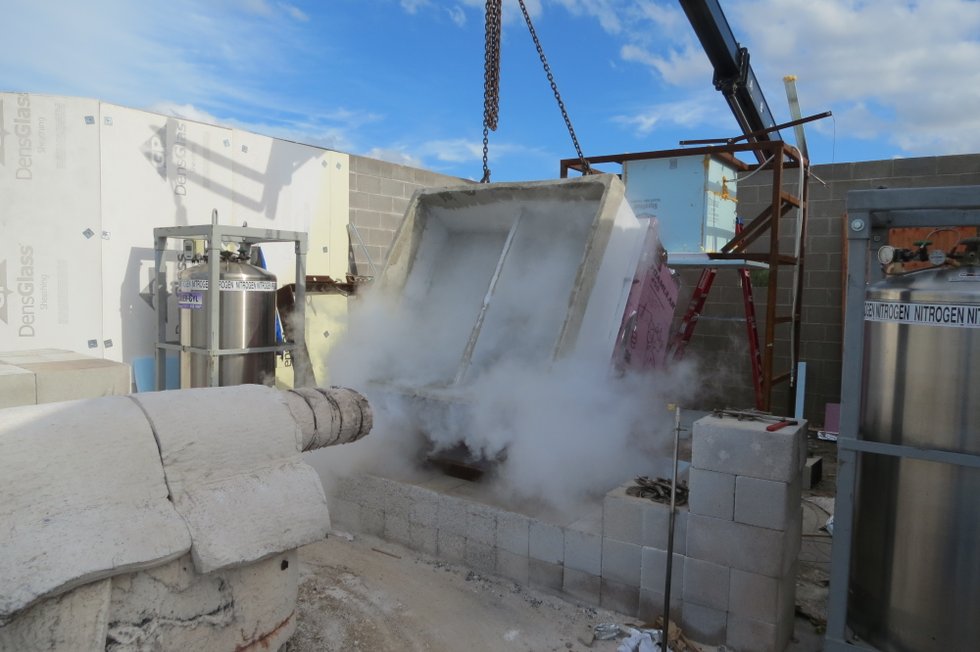
A test specimen coated in Pyrocrete 341 is seen at the conclusion of an ISO 20088-1 cryogenic spill exposure. The specimen was immediately transitioned to an ISO 22899-1 jet fire exposure.
In one test, we exposed a specimen to a severe cryogenic release, where the sample was immersed in liquid nitrogen and then moved as quickly as possible post-test, within roughly 10 to 12 minutes, to a propane‑fueled jet fire. The thermal performance showed strong correlation to a control specimen that experienced only the jet fire, indicating no meaningful loss of integrity from the prior cryogenic shock.
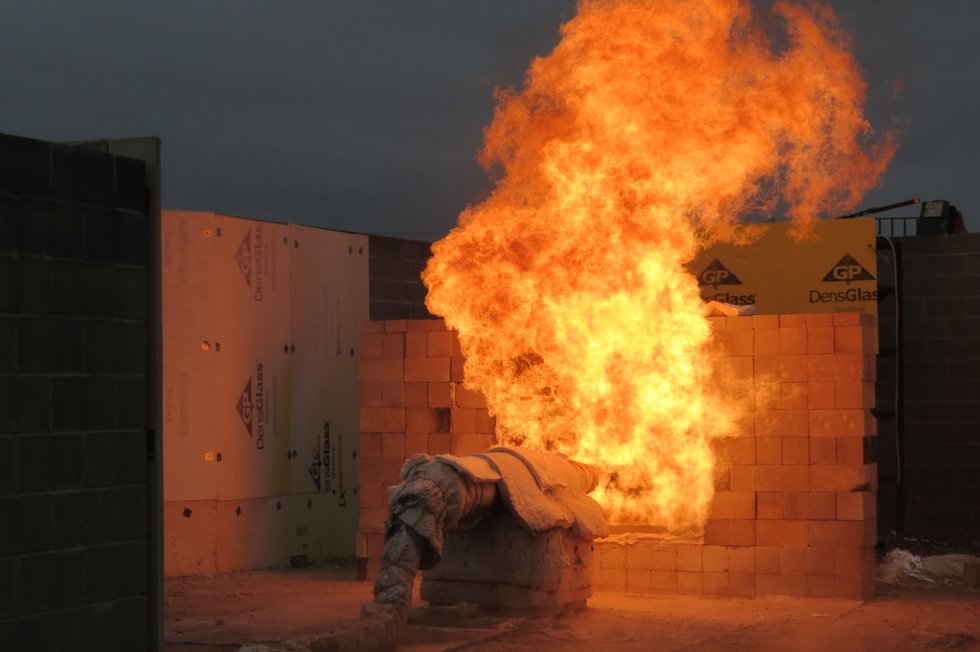
The same test specimen is seen during the ISO 22988-1 jet fire exposure. The testing validates the performance of Pyrocrete 341 in a sequential event consisting of a cryogenic spill followed by jet fire.
In the second test, we again began with cryogenic exposure but then left the specimen outdoors for 28 days before conducting the jet fire test. Despite the delay and environmental exposure, the results again closely matched the control sample.
More recently, we subjected Pyrocrete 341 to multiple pressurized cryogenic releases within a 24‑hour period to evaluate the potential effects of repeated cryogenic events that may not escalate into an explosion or fire but could still trigger maintenance and repair actions. The material showed no surface degradation, no loss of adhesion or integrity, and maintained insulating performance consistent with the preceding test.
Collectively, these results provide early but meaningful evidence that Pyrocrete 341 can withstand both immediate and delayed multi‑phase hazard sequences, cryogenic shock, repeated exposures, and subsequent fire, without repair or replacement. It’s a strong first step toward validating real‑world scenarios rather than isolated hazard phases.
Q: What do facility engineers take from this?
A: Facility engineers should take away that they now have evidence‑based grounds to simplify their decision‑making. The first step is to ask more of material manufacturers, engage them, challenge assumptions, and understand how their products perform in sequential hazard scenarios rather than isolated ones.
If you’re a process safety engineer considering Pyrocrete 341, you may no longer need extensive qualitative or quantitative analysis to determine where cryogenic spill protection is required. In standard thickness‑determination practices, the PFP thickness is the governing requirement for this product composition. Fire scenarios demand more thickness than cryogenic scenarios, even at lower critical temperatures and longer resistance periods, so specifying the fire thickness inherently provides the necessary CSP.
This simplifies engineering decisions by removing much of the subjective work around defining spill zones or probability‑based CSP boundaries. By specifying Pyrocrete 341 at the fire design thickness, CSP is effectively built in.
Most importantly, this isn’t theoretical. We’ve demonstrated actual performance in combined hazard scenarios. These were not isolated tests, so this is not implied behavior. It is verified sequential‑hazard performance.
Learn more about Pyrocrete 341 here.
Stuart Bradbury is Global Director of Fire Protection for Carboline. He guides the development of passive fire protection materials across high-hazard and infrastructure markets, leads material testing and evaluation efforts, and partners with customers worldwide to craft best-fit material specifications that protect life and property.