
New Orleans hosted the American Fuel & Petrochemical Manufacturers 123rd annual meeting this month.
The timing was hard to ignore.
Here are three key takeaways from AFPM annual meeting.
- The Strait of Hormuz is a historic supply shock: With flows dropping below 10% of normal levels, this disruption is the "mirror image" of the COVID-19 demand crash. It has set a permanent precedent for global energy insecurity and supply chain vulnerability.
- U.S. refiners hold a fragile global advantage: U.S. Gulf Coast refiners are currently the best-positioned in the world due to feedstock flexibility. However, this is temporary; once the Strait reopens, aggressive competition from Asian markets will quickly contest this lead.
- Long-term demand is proving more durable: Slower EV adoption and rising petrochemical needs mean the "death of oil" was premature. The case for long-term investment in complex refining and aviation fuel integration is stronger now than it was a year ago.
With a U.S.-Iran conflict actively playing out, the Strait of Hormuz largely shut to commercial shipping and a sweeping regulatory overhaul underway in Washington, industry leaders showed up with a lot to talk about. Over two days, energy analysts, federal officials, geopolitical strategists and refining executives worked through what the disruption means now, what it means long-term and where U.S. refiners stand relative to the rest of the world.
Here is what came out of it.
The Strait of Hormuz disruption is the biggest supply shock in market history
Dr. Amrita Sen, founder and director of market intelligence at Energy Aspects, did not ease into it. The Strait of Hormuz ordinarily handles roughly 15 million barrels per day of crude oil, 5 million barrels per day of oil products and LPG, around 85 million tons per annum of energy and 35 million tons of ethanol. Shipping through the strait is now running below 10% of normal flows.
That is the largest physical supply disruption in the history of the oil market.
About 4 million to 5 million barrels per day can be rerouted through Saudi Arabia's East-West Pipeline and the UAE's Fujairah export terminal. Both have been hit by drone attacks repeatedly. The remaining 11 million barrels per day is effectively stranded. Qatar has suspended LNG exports. Upstream production shut-ins have reached an estimated 10 million barrels per day as onshore storage fills and producers have nowhere to send crude.
Sen compared it directly to COVID-19. In March and April 2020, the world lost 20 million barrels per day of demand almost overnight. This is the mirror image, but on the supply side.
"Whatever the new normal looks like," she said, "it is not going to be the old status quo."
Willis Sparks of the Eurasia Group reinforced that point. Even after a ceasefire, flows will not normalize quickly. Iran has now demonstrated that closing the strait is a cheap, asymmetric way to create maximum economic pain for the global economy. The precedent is set. They can do it again.
Sparks outlined three scenarios that could make things significantly worse. Iran could escalate attacks on Gulf energy infrastructure beyond what has already been hit. The 5,000 U.S. Marines currently en route to the region could be ordered to take Kharg Island, Iran's primary crude export terminal, which would be a direct grip on the regime's economic lifeline and could trigger a response that changes the political calculus at home overnight. And internal fracturing within Iran's military, while the least likely scenario, could produce a civil war and a failed state.
None of those are base cases. All of them are live.
Two scenarios for what happens next
Analysts from Wood Mackenzie and S&P Global modeled two outcomes.
The base case assumes the strait is disrupted for another one to two weeks, with flows largely restored by end of March. Crude stays near $100 per barrel. Demand destruction is limited.
The oil shock scenario assumes a two-month-plus closure with infrastructure damage cutting 2 million to 4 million barrels per day in 2026. Brent crude could approach $200 in that scenario. That number sounds alarming until you inflation-adjust 2008 peak prices, at which point it is not without precedent. The bigger problem is not how high prices go. It is how long the recovery takes.
The Strategic Petroleum Reserve is not a solution at this scale. The IEA recently coordinated the largest emergency oil reserve release in history — 400 million barrels across 32 member countries. It is roughly 20 days of lost Hormuz traffic. The maximum historical U.S. SPR release rate is around 1.3 million barrels per day. Even doubled, it takes months to move that volume into the market. The East, which needs it most, will not feel meaningful relief until May at the earliest.
Sen put the market math plainly. To balance a market with 10 million barrels per day of supply losses, prices need to go high enough and stay there long enough to destroy demand. Energy Aspects has calculated that number at roughly $185 per barrel in today's inflation-adjusted terms. That does not mean crude itself has to reach $185. It means crude at $120 combined with crack spreads making up the difference gets you there.
U.S. refiners are better positioned than anyone. That will not last forever.
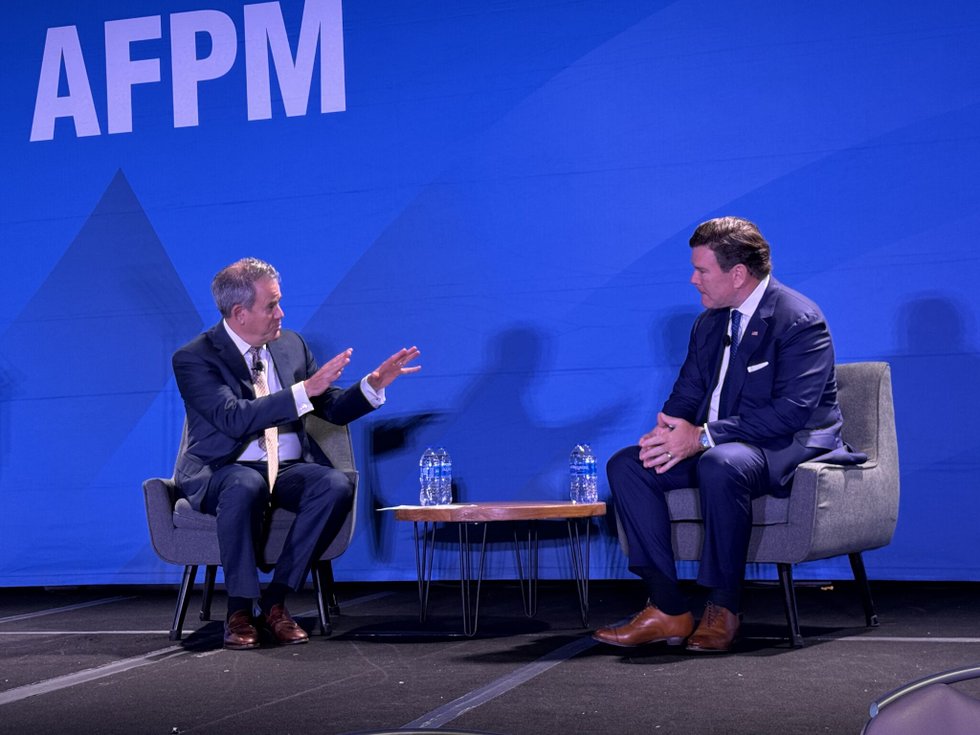
AFPM 2026
Chet Thompson, CEO, AFPM and Bret Baier, Fox News
Across multiple sessions, the consensus was the same. U.S. Gulf Coast refiners are holding the strongest hand in global refining right now. It is a short-term reality, not a permanent condition.
Sen laid out the specific opportunity. Europe needs American diesel more than at any previous point in history, because 70% of European jet fuel historically transits the Strait of Hormuz. Africa is starved of Middle Eastern diesel and jet and has no short-term alternative. Gulf Coast refiners have the feedstock, the complexity and the export infrastructure to fill those gaps.
The SPR release will deliver predominantly sour crude, which benefits complex Gulf Coast refiners equipped to process it. Venezuelan crude is expected to grow gradually toward 1.2 million barrels per day by year-end, with the bulk flowing to the U.S. Gulf Coast. That partially offsets the loss of Middle Eastern medium and heavy sours.
The warning followed quickly. Asian refiners are taking the first hit because 90% of their crude imports move through the strait. Run cuts are already happening across China, India, Vietnam and South Korea. Once the strait reopens, Asian buyers will compete aggressively for every available Atlantic Basin barrel. South Korea, with roughly 1 million barrels per day of product exports, is already discussing export freezes. China has imposed an outright product export ban. The insulation U.S. refiners feel today is real. It is also temporary.
PADD 5 deserves its own attention. Los Angeles refinery closures have removed roughly 100,000 barrels per day of domestic gasoline supply. South Korea is the primary source of jet fuel for the West Coast. If Korea freezes exports, California has no short-term replacement. Analysts flagged jet fuel as the most likely product to see genuine shortages, not just elevated prices, in the near term. California spot gasoline could reach $8 or higher.
The solution that kept coming up: pipelines. If infrastructure connecting PADD 2 and PADD 3 to PADD 5 is not built, West Coast dependence on trans-Pacific product imports is a permanent vulnerability. This conflict is making that conversation harder to ignore. It is the same argument underpinning America First Refining's Brownsville project, which is engineered specifically around domestic light shale and requires no imported feedstock.
The long-term outlook for liquid fuels is stronger than it looked 12 months ago
EV adoption in the United States has slowed sharply. Battery electric vehicle sales dropped after federal tax credits expired, and the revised baseline has pushed Wood Mackenzie's long-term demand forecasts upward. BEV market share projections have been reduced. Plug-in hybrid and full hybrid assumptions have increased. The internal combustion engine keeps getting more efficient, which still produces gradual long-term gasoline demand decline, but at a slower pace than recent consensus assumed.
This is the same dynamic Gulf Coast refiners were already navigating heading into 2026 — the pivot from volume-focused strategies to ones that maximize margin and feedstock flexibility. The Iran conflict has not changed that underlying shift. It has put a spotlight on which refiners built the flexibility to respond to it.
China is the bigger structural story. For the first time, Wood Mackenzie reclassified China from its emerging market demand growth category. Gasoline and diesel demand growth in China has flattened and is starting to decline. The country that drove global oil demand growth for 25 years is no longer doing that job.
India, Africa and the rest of Asia are growing. They are not growing fast enough to replace what China contributed.
Naphta and jet fuel were identified as the two product categories with continued long-term global demand growth. That makes petrochemical integration and aviation fuel positioning increasingly important for any complex refinery thinking seriously about 2030 margins and beyond.
The disruption of ethane, propane, butane and Naphta flows through the strait is also quietly a positive for U.S. and Western petrochemical producers. PDH margins in China are deeply negative. Feedstock-dependent Asian producers are getting squeezed. The U.S. NGL cost advantage, a direct product of the shale era, is more valuable right now than it has been in years.
EPA is moving faster on deregulation than any previous administration
EPA Deputy Administrator Dave Fotouhi addressed AFPM members directly on the regulatory agenda.
The agency has repealed the 2009 endangerment finding and all subsequent greenhouse gas regulations for light, medium and heavy-duty vehicles, projecting $1.3 trillion in regulatory cost relief. The agency has also proposed permanently removing greenhouse gas reporting obligations for 46 categories of facilities and suspending reporting requirements for the natural gas sector through 2034.
The RFS Set 2 final rule is under White House interagency review and is expected in the coming weeks. Fotouhi did not preview the final volume levels but acknowledged the supplemental notice on small refinery exemption reallocation reflects genuinely competing stakeholder interests. He confirmed the agency will move directly to Set 3 upon finalizing Set 2, specifically to avoid repeating the compliance uncertainty the industry is dealing with now.
AFPM CEO Chet Thompson put the regulatory volume in context. The prior administration issued more than 40 significant rulemakings affecting the fuel and petrochemical industries, totaling more than 300,000 pages of regulatory text. Walking that back while building legal records durable enough to survive court challenges is the work this administration has taken on.
Fotouhi was pressed on RVP waiver timing. He acknowledged the sensitivity and said the agency plans to act before the seasonal transition window closes. He did not commit to a specific date.
On permitting, EPA has issued guidance providing new flexibility to begin construction before obtaining Clean Air Act preconstruction permits, reissued the "no second guessing" memo for NSR applicability determinations and eliminated the reactivation policy that subjected idle facilities to new source review requirements when they came back online. The practical effect: restarting an idle power plant or industrial facility no longer automatically triggers the same permitting burden as building a new one.
Water scarcity is becoming an operational risk, not just a sustainability metric
A technical session on industrial water management made the case that this issue has moved past the checkbox. It is a supply chain risk.
Carlos Cavalca, VP of Operations - Business Development with Veolia North America walked through the numbers. Only 0.5% to 1% of the Earth's total fresh water is accessible for human use. By mid-century, freshwater demand is projected to exceed supply by 40% in key U.S. basins. Refiners are disproportionately located in regions where drought cycles, population growth, urban expansion and the buildout of data centers and semiconductor fabs are converging at the same time. Texas, Arizona, Georgia and California are all on that list.
Eric Ye, a process division leader with Becht, walked through where water actually goes inside a typical refinery. Cooling towers account for more than half of total consumption. Steam systems are the next largest category and also the one with the most recovery potential. He emphasized that meaningful conservation requires field validation. A desktop water balance exercise is a starting point. It is not a program.
Karen Green, corporate sustainability technologist at Marathon Petroleum, shared four case studies from across Marathon's 13-refinery system. Extending sand filter backwash intervals from every 24 hours to every 72 hours at one facility cut water use by 27 million gallons per year at essentially no capital cost. A cross-functional condensate return project at another site eliminated a rental skid and saved more than $1 million annually. A temporary groundwater connection at an LA-area refinery cut city water purchases by 75%. A Detroit facility commissioned a year-round effluent reuse system delivering 600 gallons per minute continuously after a multi-year winterization effort.
Green's consistent message: start at the operational fundamentals before pursuing capital-intensive solutions. You can have the best technology and still fail if the people running the unit are not bought in.
The panel was asked about federal regulation of industrial water use. The consensus: unlikely in the near term, but local allocation constraints are already a reality in the Colorado River basin and around Corpus Christi. Refiners were encouraged to understand their water supplier's drought management plan and build long-term water roadmaps on a five- to 15-year horizon, not treat water conservation as a one-time project.
The political picture: midterms, energy on the ballot and a year of wins
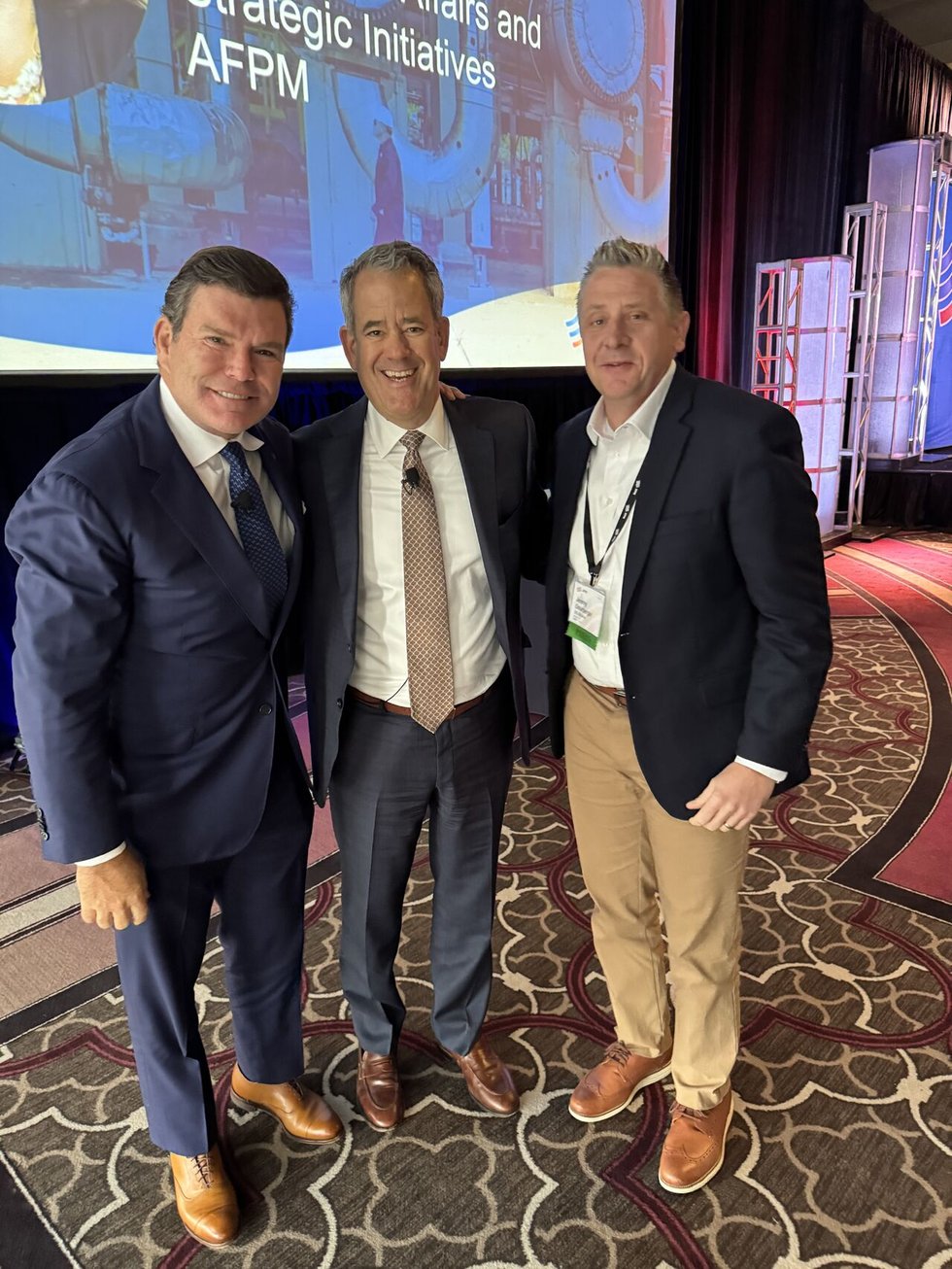
AFPM 2026
Bret Baier, Fox News, Chet Thompson, CEO, AFPM, Jeremy Osterberger, COO/President, BIC Alliance
Fox News chief political anchor Bret Baier gave a straightforward read on where Washington stands. If midterms were held today, Democrats take the House. Republicans hold the better Senate map. The administration is counting on a resolution in Iran and a strong economy in the second and third quarters to shift that picture before November. Baier said publicly that he does not think the administration's rosy projection is realistic right now.
AFPM CEO Chet Thompson opened the meeting by laying out what the industry accomplished over the past year. Congress overrode California's ban on new gasoline-powered vehicles. The Supreme Court recognized the harms posed by EV mandates to the refining sector. The endangerment finding was repealed. Tax reform passed. Russ called the combination of a Congressional Review Act victory and a Supreme Court win in the same year "a bit of a unicorn" in his experience in Washington.
He was equally clear about what still needs to happen. RFS reform is urgent. EPA's current Set 2 proposal could cost consumers an estimated $70 billion per year. Permitting reform remains unfinished after a decade of discussion. A renewed U.S.-Mexico-Canada trade framework, stable global energy markets and stability in Venezuela are all still on the list.
Willis Sparks of the Eurasia Group offered the longest-range observation of the meeting. President Trump is the first American president since before World War II to openly question whether a global leadership role for the United States serves the American people. Allies are hedging. Adversaries are testing. That geopolitical reset is not a temporary disruption. It is the new operating environment.
"This isn’t the end of the world," Sparks said. "But it is the end of the world as we know it."
What this means going forward
A few things stood out clearly across the two days.
U.S. refiners are in a strong position right now. Feedstock advantage, export optionality, complex refinery configurations and proximity to deficit markets in Europe, Africa and Latin America all matter in this environment. That advantage will be contested once Asian buyers regain supply access.
The long-term demand story is more durable than it appeared 12 months ago. EV adoption is slower than forecast. Petrochemical demand continues growing. The case for continued investment in refining and petrochemical integration is stronger than it was at last year's meeting.
The regulatory environment is shifting in a meaningful direction for this industry. Whether those shifts hold up in court is a separate question, and one the industry needs to stay engaged on.
Water is moving from a sustainability conversation to an operational one. Refiners in water-stressed regions without a long-term water strategy are taking on risk they may not fully appreciate yet.
And the Strait of Hormuz precedent is real. This is not the last time this conversation happens. Building energy security, supply chain resilience and strategic inventory depth is no longer optional planning. It is how this industry positions itself for the next disruption, whenever it comes.