
Most MRO RFPs are designed to measure what is easiest to quantify: price, rebates, payment terms and guaranteed savings.
The bigger opportunity is often buried in labor, transactions, consumption and process. Leadership comes to you with a simple ask: save money. Where do you start? What will make the biggest impact without turning into a years-long project? Organizations naturally focus on categories carrying the highest operational risk: motors, bearings, valves, electrical infrastructure and critical spares. They should. A single failure can impact reliability, production and safety.
But the better question is this: where is your workforce actually spending its time?
For many organizations, consumables represent roughly 30% of MRO spend, but they often hold the largest SKU population and generate 60% or more of all material-related transactions. The lowest-cost category often consumes the greatest amount of labor activity.
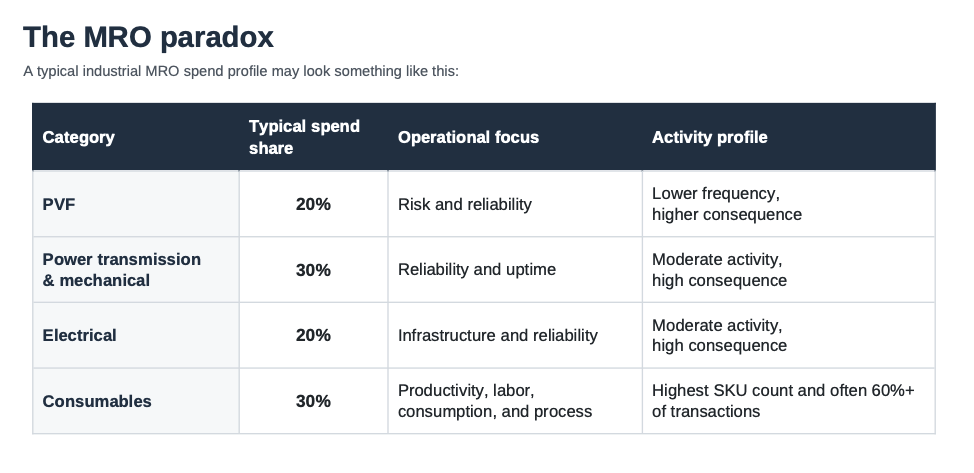
The MRO Paradox
What counts as a transaction?
Ryan Upshaw
Ryan Upshaw, Vertical Business Development at Fastenal
When most people hear transaction, they think purchase orders, invoices and supplier payments. But in MRO, the transactions that matter often happen far from the purchasing system. A transaction can mean walking to a storeroom, driving to a warehouse, going into a broom closet near a work area, searching for batteries, replenishing inventory or waiting for material to be issued. Every one of those activities consumes labor, reduces time on tool and often goes unmeasured.
Do you really have a critical spare program?
Most organizations will say critical spares are their most important inventory. I agree. But do you actually have a critical spare program, or do you simply have inventory people consider critical?
A true program considers asset criticality, failure probability, lead time, risk mitigation, stocking strategy and lifecycle management. Without that structure, you may have inventory, but not necessarily a program.
And if your critical spare strategy is immature, where is your organization spending most of its time? Usually inside the consumable space, where SKU counts, transaction volumes, employee interaction and replenishment activity are highest. The inventory that keeps most organizations awake at night may be critical spares. The inventory consuming most of their workforce's time is often consumables. Most incumbents have maintained relationships for years. That often gives them the best historical information, strongest understanding of buying patterns and clearest view of the current state.
Meanwhile, customers often struggle with incomplete item data, inconsistent material masters, missing manufacturer part numbers, inaccurate units of measure and years of unmanaged catalog growth.
Why transparency and data quality matter
I do not write this to be critical. I write it because I see it constantly: the data in material management systems for safety, PPE, abrasives, fasteners, batteries, welding consumables and other MRO consumables is often not strong enough to support the improvement expectations placed on the RFP.
If an organization puts 10,000 SKUs to market, suppliers expect accurate manufacturer part numbers, units of measure, descriptions and usage history. In reality, a much smaller subset is usually trustworthy enough for clean measurement. Every supplier likes to talk about retaining 90% of their business. Sometimes retention proves value. Sometimes it simply proves that change is difficult. One of the greatest challenges in MRO is how much time organizations spend discussing piece price.
The MRO paradox
A typical industrial MRO spend profile may look something like the table above. We benchmark it, negotiate it, build RFPs around it and measure savings against it. Yet product cost is only one component of total cost of ownership. Labor, movement, procurement effort, material handling, inventory management, replenishment activity, emergency purchasing, downtime and consumption behavior often represent a much larger opportunity.
Common RFP missteps
Large line-item RFPs happen for understandable reasons. Teams want contracted pricing on everything, so some events include 10,000 line items. But that approach often creates complexity without creating clarity.
A better starting point is a smaller, cleaner market basket of 500 to 1,000 items: the highest movers, highest usage items and products that best reveal current behavior.
One practical rule I like is this: if an item is purchased more than four to six times per year, it should be reviewed for the contracted file. The price file should represent what the organization actually uses, not what someone thinks it might need someday. If you understand what you buy, how you buy it, where it goes and how it is consumed, the second and third years of a contract become much more powerful.
That is when a supplier can help drive standardization, SKU rationalization, substitution opportunities, consumption reduction, automated replenishment, point-of-use inventory strategy, tail-spend reduction and supply chain resiliency.
How to build a better RFP
A better RFP does not need to be complicated. It needs to be measurable, here's how:
- Limit SKU counts to a focused market basket tied to actual usage.
- Prioritize the highest movers and largest spend items.
- Use manufacturer part numbers and clean units of measure wherever possible.
- Understand how products are ordered, distributed, replenished, consumed and paid for.
- Require measurable operational outcomes, not just commercial offers.
The goal should be to build structure inside the consumable categories so the program can improve over time, respond to change and create better decisionmaking through cleaner data.
At the end of the day, most organizations do not have a pricing problem. They have a process problem. We spend months building RFPs, evaluating suppliers, negotiating rebates, discussing payment terms and measuring projected savings. Then we award the business and move on. The best supplier is not always the one with the lowest price. It is the one that helps create measurable operational change.
At some point, the conversation stops being about who can quote a better glove, battery, abrasive, fastener or welding rod. It becomes about who can reduce transactions, improve time on tool, increase transparency, simplify processes and build a better system.
And that is why most MRO RFPs miss the point.
Remember these three: Price tells you what you paid. Process tells you what it actually costs. And operational change is where value gets created. Every organization wants savings. The real question is where those savings will come from. If you're ready to move beyond rebates and piece-price discussions and take a closer look at the processes driving total cost of ownership, reach out to Fastenal for a conversation about what operational improvement could look like in your environment.
For more information, visit fastenal.com.