
In 1968, social psychologists Bibb Latané and John Darley investigated the responses of 72 college students to determine whether the number of people who witness an emergency has any influence on whether people are inclined to help.
They found that only 62% of the participants intervened when they were part of a group of five bystanders.
"This was back in what they called the ‘golden years’ of clinical psychology. We’ve evolved since then as an industry and as a science," said Jordan Burklow, health and safety team lead with LYB. "These studies continue today because we’re trying to be correct in terms of cultural and societal differences.
"But we keep coming back to the same thing," he said. "There’s something here that Latané and Darley touched on that is at the root of group dynamics."
Latané and Darley dubbed their findings ‘The Bystander Effect.’
Formally, The Bystander Effect is a psychological phenomenon that occurs when the presence of others discourages an individual from intervening in an emergency situation. Simply put, The Bystander Effect is a psychological phenomenon where the likelihood of someone taking action in an at-risk situation decreases as the number of people in the group increases. In a presentation at the EHS Seminar and Industry Tradeshow in Galveston, Texas, Burklow explained how the Latané and Darley study pertains to today’s workplace.
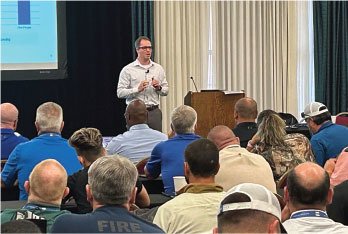
LYB’s Jordan Burklow presents during the EHS Seminar and Industry Tradeshow in Galveston, Texas.
"When Latané and Darley wrote this down from a behavioral standpoint, they said, ‘What is getting in the middle and breaking that chain that is causing people to not act, or to delay their action in an emergency?’" Burklow said. "First is the diffusion of responsibility: ‘As I have more people around me, the less responsible I feel for taking action on what’s happening.’"
When responsibility is dispersed, people may assume that someone else will help or that someone else is better qualified to help, Burklow said. "The fallacy in this line of thinking is that if everyone assumes this, then no one will act."
Burklow shared that there is, or appears to be, a clear correlation between the number of people and the actions of those who try to help or assist in what they perceive to be an emergency.
"Taking it one step further, they said that when a person is alone, they assisted in about 50 seconds. If there are two people, it’s 160 seconds," he said. "So not only are you less likely to act in an emergency when you’re in a group of people, it’s going to take you longer to act."
There are proven methods that are effective in combatting the diffusion of responsibility, Burklow said.
"Realize that your first instinct and the first instinct of those around you will be to deny responsibility for helping identify the situation at risk," he explained. "By simply being aware of the diffusion of the responsibility process, it may snap you out of the biased way of thinking and cause you to realize that you and everyone present is each 100 percent responsible for speaking up."
Further, if someone is trying to get others to move to action in assisting with the situation, Burklow said, it is helpful to give specific instructions to specific people.
"This counteracts the diffusion of responsibility process by making each person feel directly involved and responsible," Burklow said. "If you find yourself in an ambiguous situation, resist the urge to look to others. If you think there is even a possibility that a situation may be at risk or lead to an accident, act on it. At worst, you will embarrass yourself for a few minutes, but at best, you could possibly save someone’s life.
"If you were on the other end of that, would you want somebody to help you — or your son or your daughter?" Burklow said. "Make it personal."
For ongoing industry updates, visit BICMagazine.com.