
For decades, the construction industry has invested heavily in safety meetings, toolbox talks and short-form training interventions designed to improve worker behavior and reduce incidents.
While these programs are sometimes criticized as repetitive or overly simplistic, a new study of construction workers proves that even small changes can change behavior and enhance learning transfer. The study, Safety Training in Construction: Do Toolbox Trainings Work, found repeated toolbox-style trainings led to statistically significant gains in safety knowledge. The study found that the practical value of toolbox training lies not simply in compliance, but in its ability to repeatedly reinforce safe behaviors until they become part of workers’ everyday decision-making and subconscious actions on the jobsite.
With this in mind, and as the construction industry faces significant suicide and mental health crises, NCCER wanted to see if its Talk Save Lives course could have that same effect. Talk Saves Lives was developed in partnership with the American Foundation for Suicide Prevention (AFSP), and is deliberately designed to be a brief, accessible and workforce-oriented intervention with immediately applicable strategies for construction workers and supervisors to address challenges around suicide awareness and prevention.
The NCCER study
Can a one-hour training increase suicide awareness and preparedness?
To evaluate the impact of NCCER’s Talk Saves Lives course on perceptions and preparedness, a baseline was established before training. From March through May of 2026, over 1,200 participants helped answer several practical workforce questions:
- Do construction workers recognize suicide and mental health challenges as a legitimate issue within the industry?
- Do they know where to direct someone for help?
- Do they feel prepared or confident enough to step in if they observe warning signs?
During that same timeframe, NCCER partnered with Brasfield & Gorrie, a nationally known construction contractor, which supported the study by allowing craft workers in training to complete NCCER’s Talk Saves Lives course and complete a survey about their experience. A total of 423 participants provided insight into the training’s impact and their abilities to engage in suicide awareness and prevention efforts. Our questions were asked using a 5-point Likert scale, which measured responses on a scale of 1 – strongly disagree to 5 – strongly agree.
What we found from the survey
Can a one-hour training increase suicide awareness and preparedness?
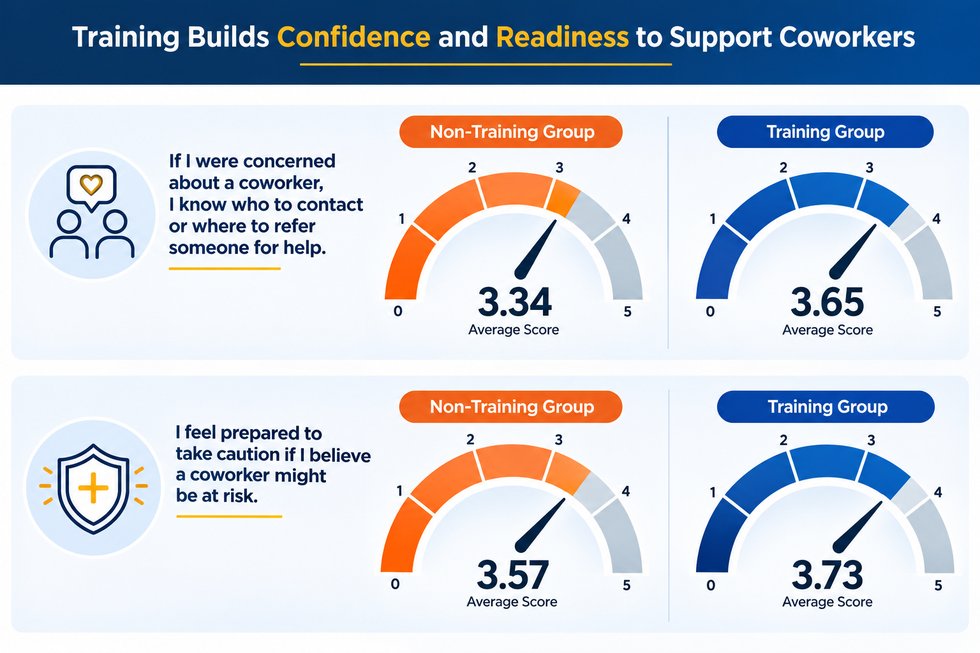
Craft workers who completed training reported greater confidence in knowing who to contact or where to refer a coworker for help. Workers who completed training also reported greater preparedness to act if they believed a coworker might be at risk.
These findings are particularly important because they reflect several core beliefs associated with transfer of learning and the ability to help influence individual behavior on the jobsite:
- increased awareness,
- increased confidence,
- improved resource knowledge
- and increased willingness to engage in intervention behavior.
In other words, and most importantly, the training appears to have influenced not only what workers know, but how prepared they feel to apply that knowledge in real-world situations.
Why these findings matter
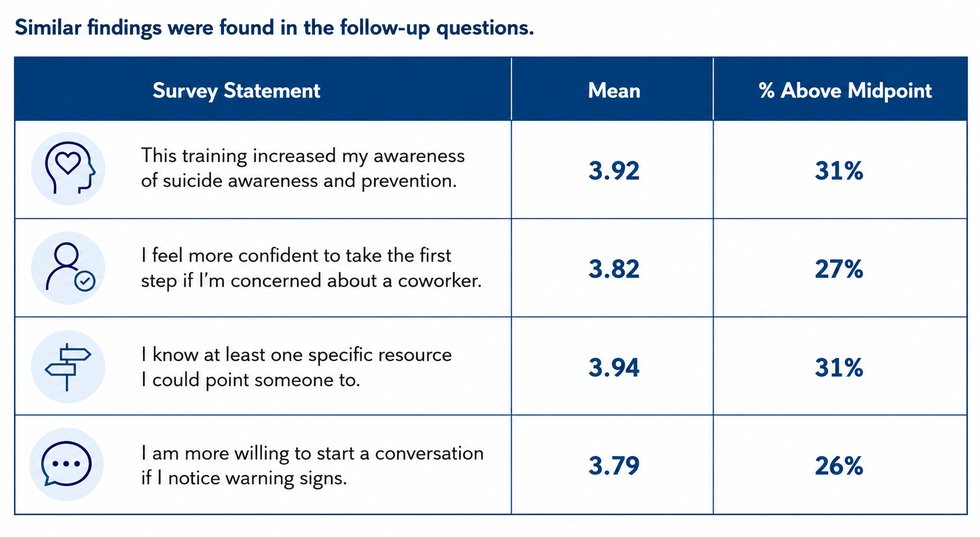
One of the strongest findings reflected workers’ confidence in identifying a specific resource they could recommend to someone in distress. This suggests the Talk Saves Lives training reduces one of the largest barriers to intervention in construction environments: uncertainty about what to do next.
Similarly, our finding that workers became more willing to start conversations after training may represent one of the clearest indicators of behavioral and learning transfer. In construction culture, where conversations surrounding mental health can carry stigma, the willingness to have sensitive conversations represents a meaningful cultural shift. Like the study Do Toolbox Trainings Work mentioned at the beginning of this article, our study shows that even short, accessible and scalable training, such as Talk Saves Lives, can have a meaningful organizational impact.
Construction leaders have long understood that safety culture is not built through a single orientation or annual meeting. Culture is shaped through repeated conversations, reinforced expectations and small moments that influence how workers respond in the field. Our findings suggest that suicide awareness and prevention training for the construction workforce may function in the same way. Even brief, free interventions like Talk Saves Lives can help workers feel better prepared to recognize warning signs, start difficult conversations and direct coworkers to support. In an industry where workers already look out for one another physically, these findings suggest mental health awareness may increasingly become another important part of what it means to work safely.
For more information, visit nccer.org.