
Industrial facilities have made significant investments in blast-resistant buildings, hardened control rooms and facility siting studies to protect personnel and critical operations.
Yet one of the most overlooked vulnerabilities in many facilities remains the overhead door.
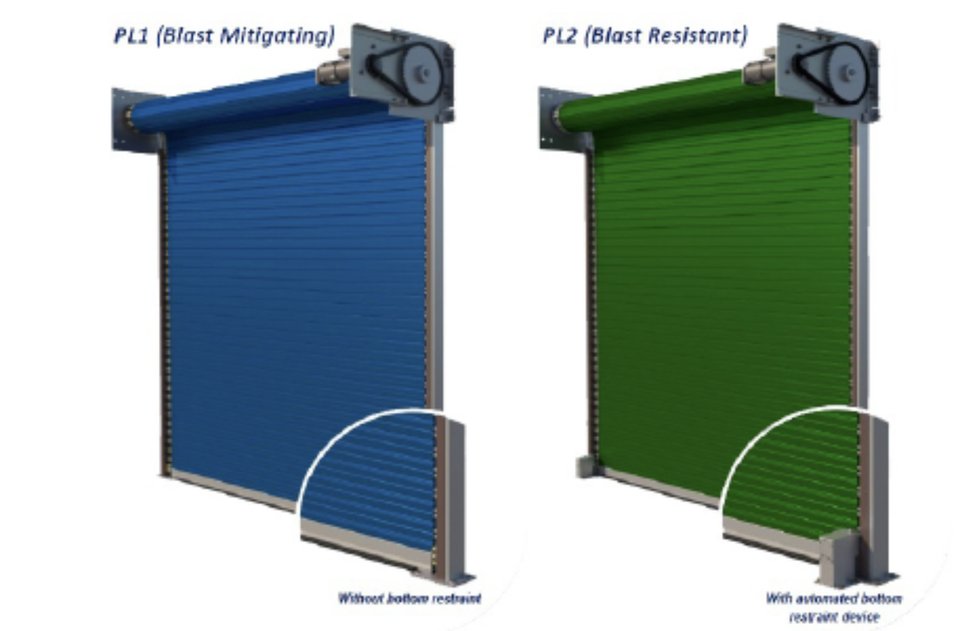
Large overhead openings are essential for manufacturing plants, refineries, petrochemical facilities, terminals and warehouses, providing access for equipment, vehicles and materials. However, conventional overhead doors are rarely designed to withstand explosion loads. Even when surrounding walls and structural framing are engineered for blast resistance, the overhead door can become the weakest point in the building envelope.
Designing a blast-resistant overhead door requires far more than increasing the thickness of steel. The door must safely resist high transient pressure and impulse loads while transferring those forces into the supporting structure without catastrophic failure or creating secondary debris hazards.
Blast Resource Group has partnered with Homegard Pte. Ltd., a wholly-owned subsidiary of GDS Global Limited, listed on the Singapore Exchange, to be the distributor of Gliderol's patented blast-resistant roll-up door products in the United States.
The Gliderol blast-resistant, blast-mitigating overhead door system addresses this challenge by combining engineered blast performance with practical industrial operation. The system is designed for facilities where large equipment access, operational reliability and personnel protection are key project requirements.
Featuring reinforced door construction, heavy-duty guide assemblies, engineered anchorage and specialized hardware, the Gliderol system can be designed to satisfy project-specific blast criteria established through facility siting studies, consequence analyses or owner performance standards. This flexibility makes it well suited for maintenance facilities, process buildings, fire stations, equipment shelters and other industrial structures requiring large clear openings.
Selecting the right door, however, is only part of the solution. Blast-resistant overhead doors should be incorporated early in project development so structural engineers can account for support reactions, connection detailing and interface requirements with the primary building frame. Early integration reduces redesign costs while ensuring the entire protective envelope performs as intended.
Purpose-built systems such as the Gliderol blast-resistant overhead door provide owners with a proven solution, assessed by ABS Consulting through Finite Element Analysis (FEA) and validated through shock tube testing, that combines operational efficiency with engineered blast performance. When integrated by experienced blast engineering professionals, these systems eliminate one of the most common vulnerabilities in industrial buildings while preserving the functionality modern operations demand.
Blast Resource Group partners with owners, EPCs, general contractors, architects and structural engineers to establish project-specific blast design criteria and integrate Gliderol blast-resistant overhead door systems into both new construction and retrofit projects, delivering facility resilience without sacrificing operational efficiency.
For more information, visit blastresourcegroup.com.