
NOTE: The sponsor of this content may contact you with more information on this topic. Click here to opt-out from sharing your email address with this sponsor. (This link will not unsubscribe you from any other BIC email list).
AMPP TM21549 testing provides a standardized method for assessing how effectively ROCKWOOL’s ProRox stone wool with CR-Tech mitigates corrosion under realistic wet/dry operating conditions.
Pipelines are among the most underappreciated assets in an industrial facility. Like roads, they make the flow of goods possible, and anything that threatens this process deserves attention. Corrosion under insulation (CUI) is one of the most persistent asset-integrity challenges facing industrial facilities, particularly pipelines.
Pipelines can corrode beneath insulation and jacketing, and the damage can progress for extended periods without being visible during routine inspections. By the time damage is discovered, significant wall loss may already have occurred, increasing the risk of leaks, equipment failure, unplanned outages, and costly repairs.
The challenge affects facilities across refining, petrochemical and chemical processing, oil and gas, power generation, and other process industries. Although inspection and maintenance remain essential to managing CUI, greater attention is also being paid to the role insulation systems themselves can play in reducing the risk of corrosion.
One development is ROCKWOOL Technical Insulation’s CR-Tech (Corrosion Resistant Technology), a proprietary corrosion inhibitor incorporated into ProRox stone wool insulation. This approach combines stone wool’s established thermal and fire-performance characteristics with an active mechanism that helps mitigate corrosion when, not if, moisture intrudes an insulation system.
But determining how effectively an insulation system performs under CUI conditions requires testing that goes beyond basic material properties. A new test method released in 2024 from the Association for Materials Protection and Performance (AMPP) offers a standardized way to make those comparisons.
Recreating the conditions that drive CUI
CUI typically begins when water from rain, condensation, or process leaks penetrates an insulation system through the outermost jacketing and reaches the underlying metal surface. Damaged jacketing, poorly sealed joints, or compromised insulation can all provide pathways for moisture.
Once moisture becomes trapped, elevated process temperatures (typically between -12°C and 175°C (10°F to 350°F)) and repeated thermal cycling can create conditions conducive to corrosion. Wetting and drying may occur repeatedly throughout the equipment's operating life, making the behavior of the complete insulation system an important consideration for CUI management.
Laboratory testing has long been used to study these conditions, but accurately comparing insulation materials can be difficult when test configurations, exposure conditions, and evaluation methods differ.
AMPP TM21549-2024, Test Method for Assessing the Impact of an Insulation Material on the Corrosion of Austenitic and Ferritic Steels under Laboratory Conditions, was developed to provide a more consistent framework.
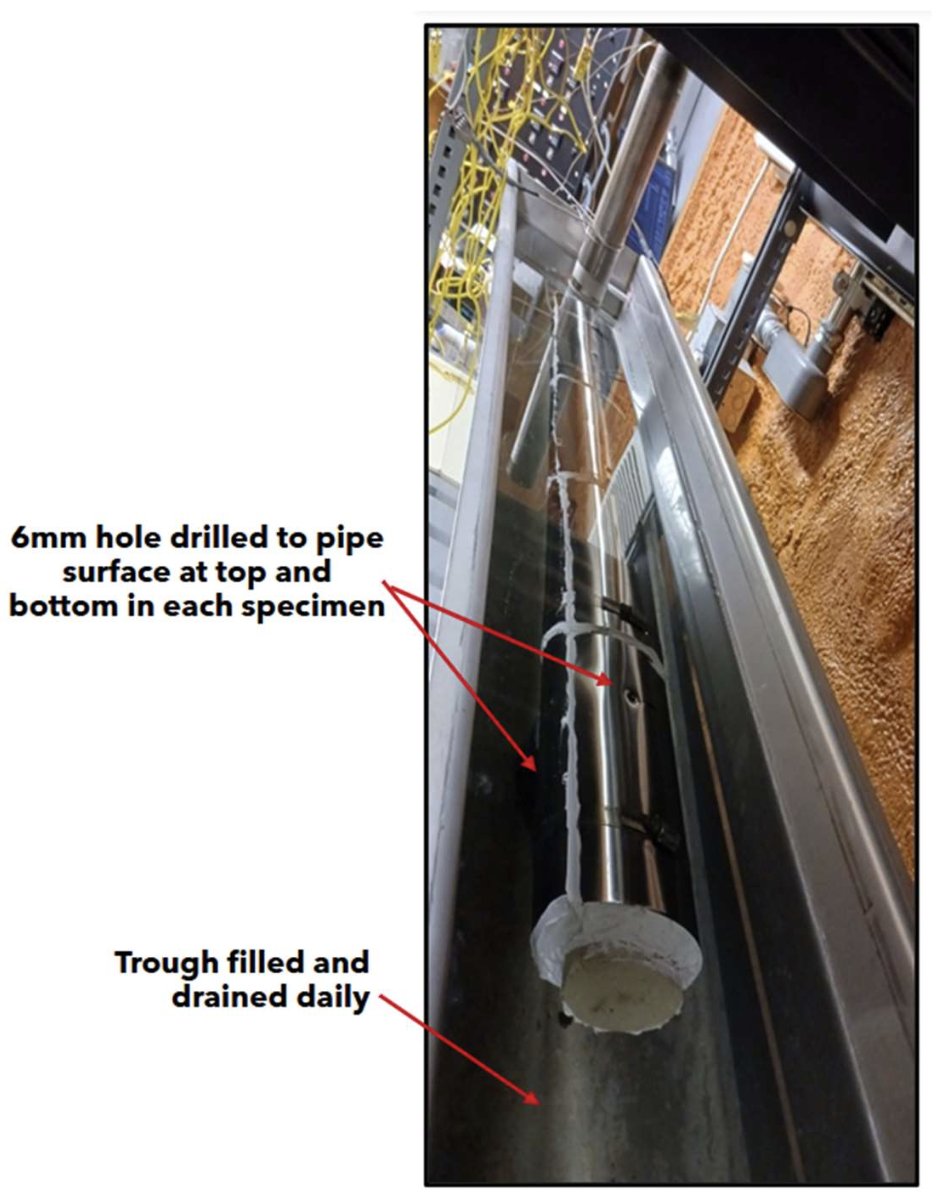
Rather than establishing a simple pass/fail criterion, the method evaluates the relative effects of different insulation materials on corrosion under controlled, accelerated conditions. It subjects insulated pipe specimens to repeated wet/dry and hot/cold cycles to simulate key elements of the CUI environment. The test specimen sits in a trough that is filled and drained with test solution on a daily basis. (Figure 1)
The method includes configurations for both low- to moderate-temperature and higher-temperature testing. Prepared steel pipe specimens are insulated and jacketed using representative installation practices, and openings (pre-drilled holes) in the insulation and jacketing allow the test solution to reach the pipe surface during wet cycles.
This is an important distinction. TM21549 evaluates insulation around pipe specimens rather than relying solely on small corrosion coupons, allowing the test assembly geometry to more closely represent an actual installed piping system.
Rockwool
Subjecting insulation systems to repeated wet/dry cycles
The rest of this article discusses a set of tests completed in accordance with the TM21549 method. In the tests evaluated here, uncoated carbon-steel pipe specimens were wrapped with insulation in accordance with the manufacturer’s installation guidelines. Two different insulation types were tested—ProRox PS 965 with CR-Tech and an aerogel blanket insulation. A third set of coupons was evaluated without insulation and served as control specimens.
Testing continued for 12 weeks using repeated wet-and-dry cycles. During the first four weeks, deionized water was used as the wetting solution. For the remaining eight weeks, the specimens were exposed to a 1,500-ppm chloride solution, increasing the severity of the corrosive environment according to the method.
Figure 1. Representative test setup during a wet cycle.
Temperatures also alternated during the weekly cycling program, with the specimens exposed to both ambient (70°F [21°C]) and elevated-temperature (300°F [149°C]) conditions. Weekends provided an extended drying period.
Upon completion of the test, the pipe specimens were visually inspected, cleaned, and evaluated for general and localized corrosion. Weight loss was used to calculate overall corrosion rate, while pitting analysis provided information on localized attack.
The distinction between these measurements is important. General corrosion indicates the overall rate of metal loss across a surface. Localized pitting, however, can penetrate deeply within a relatively small area and may therefore pose a significant threat to integrity even when the total metal loss is modest.
Testing reveals differences in localized corrosion
The test program demonstrated measurable differences between the two insulated systems.
Based on weight-loss measurements, the test showed an average calculated corrosion rate of 0.14 mm/year for ProRox PS 965 with CR-Tech and 0.16 mm/year for the aerogel specimens.
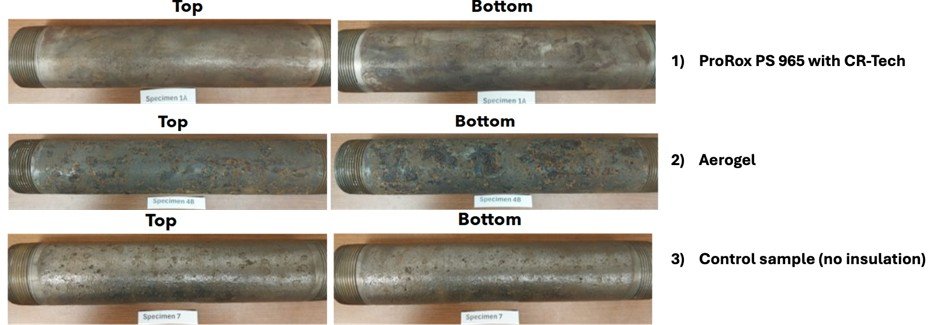
Figure 2. Representative pictures of carbon steel samples after testing and cleaning.
Rockwool
Measured pit depths for the three ProRox PS 965 specimens were 10, 50, and 100 micrometers. Pit depths for the aerogel specimens were considerably greater, measuring 200, 240, and 300 micrometers.
The results suggest that while overall metal loss was relatively similar for the two insulation systems, the stone wool containing corrosion inhibitor technology provided greater resistance to localized pitting under the test conditions.
That distinction has practical importance because deep localized corrosion can lead to rapid wall penetration and unexpected equipment failure.
The observed performance may result from a combination of factors. Stone wool has a vapor-open structure that can promote drying and moisture dissipation. The embedded inhibitor provides an additional corrosion-mitigation mechanism when moisture reaches the metal surface.
By comparison, insulation systems that retain moisture at the pipe surface for longer periods may create conditions that are more favorable to localized corrosion.
A more standardized basis for insulation decisions
No laboratory test can replicate every variable encountered in an operating facility. CUI behavior is influenced by equipment temperature, environmental exposure, jacketing condition, installation quality, insulation properties, contaminants and maintenance practices, among other factors.
TM21549 should therefore be viewed as a comparative tool rather than a predictor of exact field corrosion rates.
Its value lies in providing a consistent framework for exposing different insulation systems to the same accelerated CUI conditions and then measuring their effect on both general and localized corrosion.
For owner/operators, engineers, and materials specialists, it can provide an additional useful data point when evaluating insulation as part of a broader CUI management strategy.
The test method also complements existing laboratory approaches, such as ASTM G189. A notable distinction from ASTM G189 is TM21549-2024’s use of relatively large pipe specimens configured as insulated systems, which helps bridge the gap between small-scale laboratory testing and field-installed piping.
As the industry continues to improve its understanding of CUI, standardized comparative testing can help decision-makers look beyond thermal performance alone and consider how insulation-system design may influence corrosion behavior over time.
The results of this study demonstrate why that broader evaluation matters. Under the test conditions, stone wool with embedded corrosion-inhibitor technology and aerogel produced similar overall corrosion rates, but the stone wool specimens exhibited substantially shallower localized pits.
For facilities seeking to reduce CUI risk, these findings indicate that insulation incorporating corrosion-mitigation technology can provide an additional layer of protection as part of a comprehensive strategy that also includes appropriate system design, installation, inspection and maintenance.