
NOTE: The sponsor of this content may contact you with more information on this topic. Click here to opt-out from sharing your email address with this sponsor. (This link will not unsubscribe you from any other BIC email list).
Hot spots in fired heaters are often an early warning of failure that can escalate rapidly into a significant operational and financial risk. What may begin as a localized temperature anomaly can quickly develop into widespread refractory damage, compromising equipment integrity and potentially leading to unplanned shutdowns costing upwards of $1 million per day.
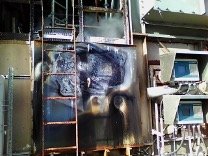
A typical hot spot on a fired heater shell
This article examines the primary causes of hot spots, methods for effective inspection, and modern repair strategies that allow operators to address damage without interrupting production. Real-world case studies highlight how these approaches can mitigate risk while maintaining operational continuity.
Understanding the challenge of hot spots on fired heaters
Fired heaters play a critical role in hydrocarbon processing, where consistent temperature control is essential for both process efficiency and equipment longevity. The refractory lining within these units serves as a thermal barrier, insulating the external steel shell and maintaining the high-temperature environment required for operation.
Hot spots typically appear on the external shell when this refractory lining becomes compromised. Because the internal condition of the refractory cannot be directly observed during operation, these external temperature anomalies are often the first visible indication of a developing problem.
Refractory maintenance is generally performed during planned shutdowns. However, when issues occurs unexpectedly, operators may face difficult decisions between continuing operation under degraded conditions or initiating an unplanned shutdown, both of which carry significant cost implications.
Common causes of hot spots
Two primary mechanisms account for most hot spot occurrences in fired heaters: refractory anchor failure and localized refractory degradation due to flame impingement.
Refractory anchor failure
Anchors secure the refractory lining to the heater shell. Failure typically originates at the weld point between the anchor and the external steel casing and can progress through the following sequence:
- Hot flue gases penetrate through the refractory lining
- These gases condense upon contacting the cooler outer shell
- Corrosion or oxidation weakens the anchor weld
- Loss of anchor support leads to refractory detachment
Once sections of refractory fall away, adjacent areas become increasingly vulnerable, often resulting in a cascading failure effect.
Flame impingement
Unless specifically accounted for in the design, direct flame contact with the refractory can cause localized overheating. Over time, this leads to premature degradation of the lining, reducing its insulating capability and allowing heat to transfer to the shell.
Consequences of hot spots
If left unaddressed, hot spots can lead to a range of interconnected issues that impact both safety and performance:
- Accelerated shell oxidation and material degradation
- Localized overheating leading to creep or deformation
- Loss of structural integrity in critical components
- Reduced thermal efficiency and increased energy consumption
- Escalation into widespread refractory failure
- Increased likelihood of unplanned shutdowns
Early detection and intervention are therefore critical to preventing minor defects from evolving into major failures.
Inspecting fired heaters for damage
Because internal refractory conditions cannot be visually assessed during operation, specialized inspection technologies play a key role in diagnosing hot spot issues.
Advanced high-temperature inspection systems allow operators to perform internal furnace inspections while the unit remains online. These systems utilize high-resolution digital imaging capable of capturing detailed visuals at temperatures up to 3000°F (1650°C). Inspection equipment can typically be inserted through openings as small as 3 inches (7.62 cm) and reach distances of up to 20 feet (6 meters). For lower-temperature applications, integrated lighting systems provide enhanced visibility.
Conducting inspections while the heater is in operation offers several advantages:
- Identification of damage at an early stage
- Improved understanding of internal conditions
- Ability to plan maintenance activities proactively
- Reduction in unnecessary or premature shutdowns
- Optimization of repair scope and scheduling
This approach enables more informed decision-making and supports a transition from reactive to predictive maintenance strategies.
Repairing hot spots without shutdown
When a hot spot is identified, operators traditionally face limited options - shut down the unit for immediate repair or continue operating at reduced capacity until the next planned turnaround. Both approaches carry operational and financial drawbacks.
An alternative solution is online refractory repair, which allows damage to be addressed while the heater remains in service. This method involves:
- Creating small, controlled access points in the heater casing
- Inserting specialized hardware and repair materials
- Rebuilding or reinforcing the refractory lining internally
- Restoring insulation performance without interrupting operations
These repairs are typically designed as semi-permanent solutions, providing reliable performance until the next scheduled outage.
Case study 1: Online refractory repair prevents shutdown in steam methane reformer
A refinery operating a steam methane reformer identified multiple hot spots on the external shell, indicating severe refractory degradation. With approximately 18 months remaining until the next planned turnaround, the situation posed a significant risk of forced shutdown.
Escalating conditions
Initial hot spots measured approximately 482°F (250°C) but rapidly intensified:
- Temperatures exceeded 1112°F (600°C)
- The number of affected areas increased significantly
- Shell condition deteriorated due to prolonged exposure
A detailed inspection revealed that the extent of damage was far greater than originally assessed, with hot spots identified across both the radiant section and transition duct.
Online repair implementation
Repairs were executed while the unit remained at full operating capacity. The approach included creating minimal access points, installing specialized components, and restoring refractory integrity internally.
Results
- All identified hot spots were successfully mitigated
- Furnace integrity was restored without interrupting production
- The repair is expected to remain effective through the next turnaround
- A potential emergency shutdown, and associated production losses, was avoided
Case study 2: CCR heater repair avoids $15 million in losses
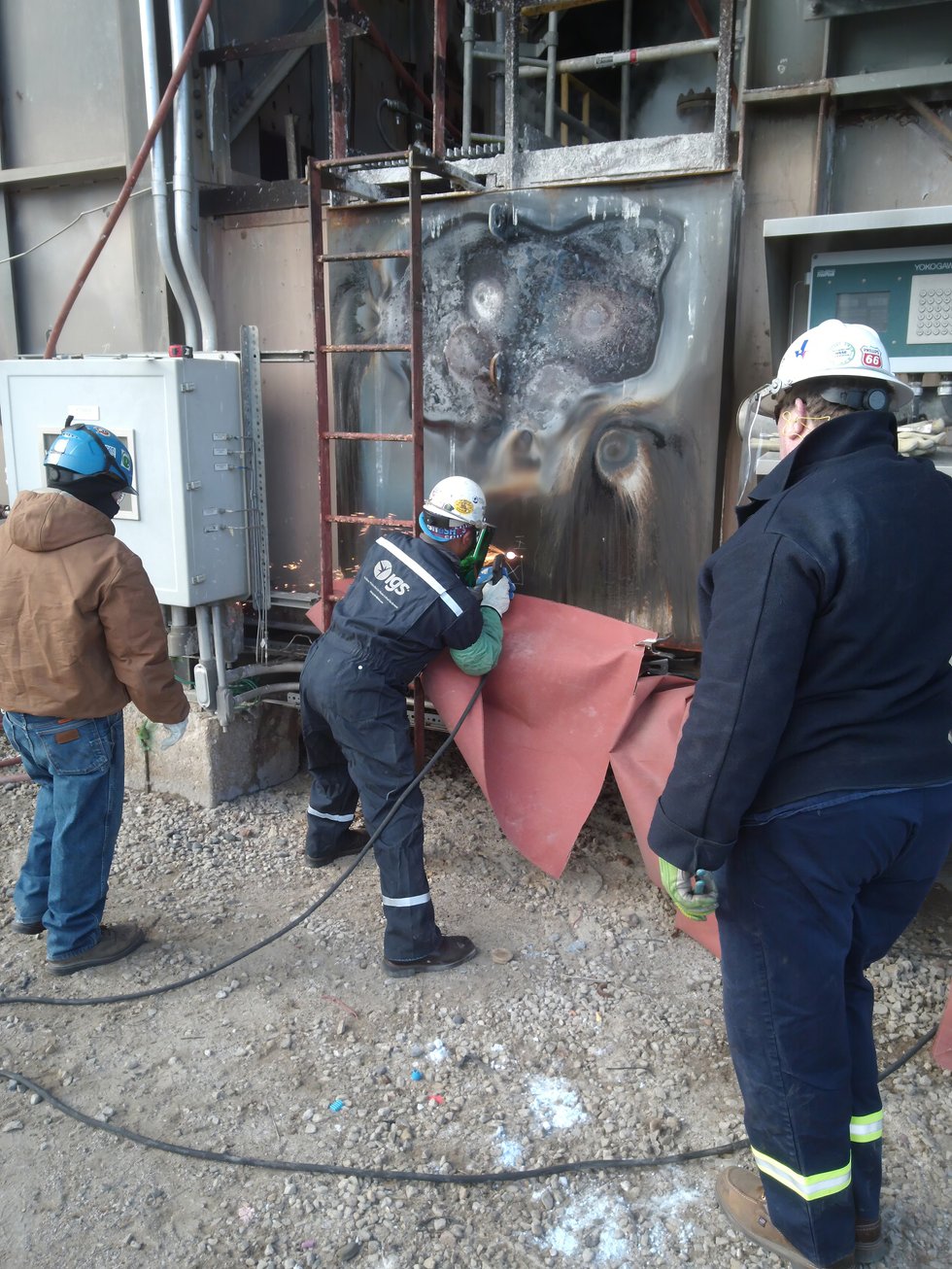
Repairing a hot spot on a live fired heater
A refinery encountered a critical situation involving multiple anchor failures on the roof of a continuous catalytic reformer (CCR) heater. The failure caused sections of refractory lining to detach, exposing the steel shell to extreme temperatures.
Critical conditions
- Shell temperatures reached approximately 1300°F (700°C)
- Structural components were exposed and at risk of failure
- Large openings formed in the heater casing
- Detached refractory material created safety and operational concerns
Repair strategy
An online repair approach was implemented to stabilize the unit without disrupting production. The scope expanded following inspection to include additional areas of concern across the furnace system.
Results
- Extreme temperatures were eliminated across affected areas
- Structural integrity was restored
- Over 200 square feet of refractory lining was repaired
- Approximately $15 million in lost production was avoided
- The solution is expected to provide multiple years of reliable performance
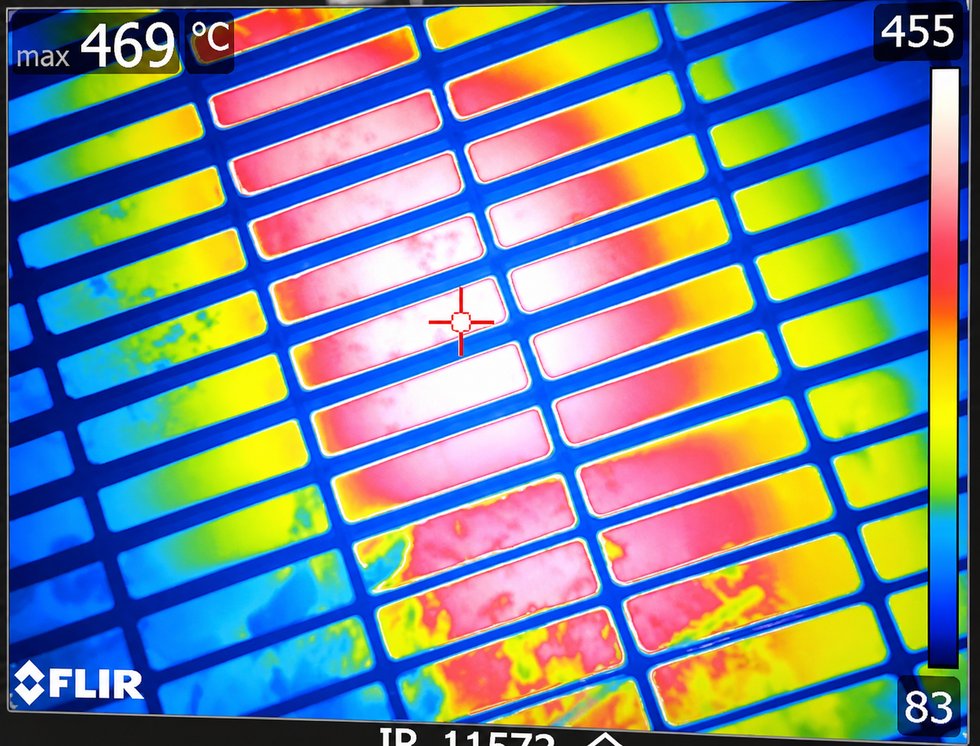
South 5: Hot Spot Before – 876°F (469oC)
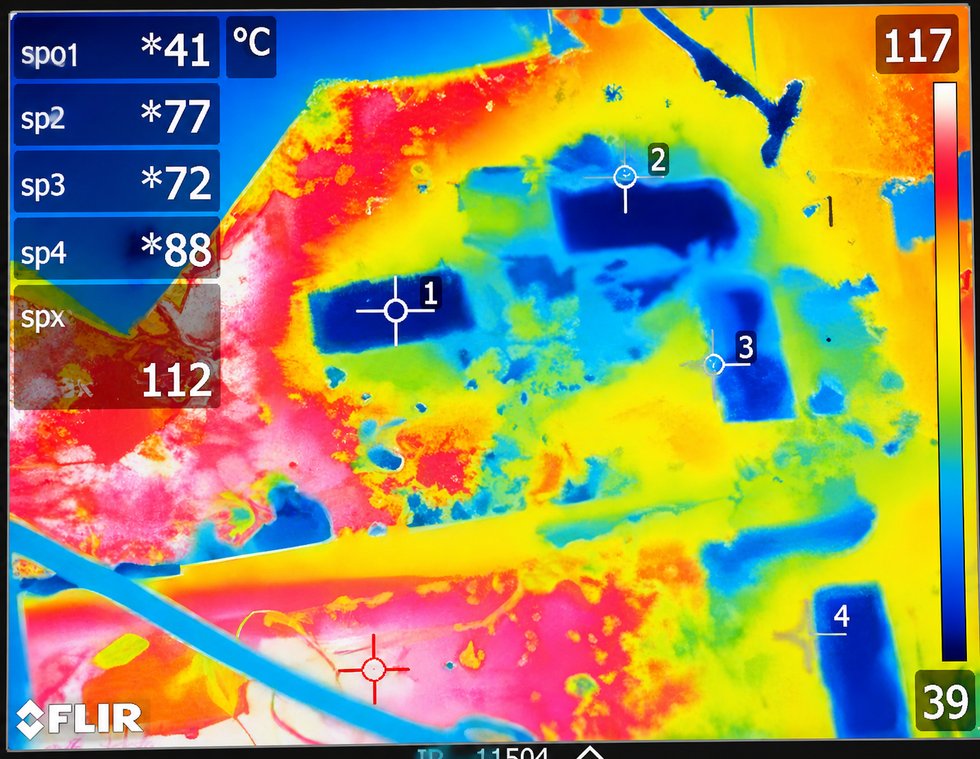
South 5: Hot Spot After – 234°F (112oC)
Conclusion
Hot spots in fired heaters pose a critical maintenance challenge and can escalate rapidly if not addressed. While traditional repair methods often require costly downtime, advances in inspection and repair technologies now provide viable alternatives that support continued operation.
High-temperature inspection tools enable accurate, real-time assessment of internal conditions, allowing operators to identify and prioritize issues before they become critical. When combined with online repair techniques, these capabilities offer a practical and effective way to manage hot spots without sacrificing production.
As the industry continues to prioritize reliability and efficiency, the adoption of these modern approaches is becoming increasingly important. Facilities that implement proactive inspection and online repair strategies are better positioned to reduce risk, optimize maintenance planning, and maintain the long-term integrity of their fired heater assets.
The future of fired heater maintenance lies in these modern technologies and methodologies that prioritize both operational continuity and equipment integrity. Plants that adopt such solutions position themselves to achieve greater operational efficiency, reduced maintenance costs, and improved long-term reliability of their critical equipment.
To see how operators are avoiding costly shutdowns and extending run lengths through online hot spot repair, visit: www.integratedglobal.com.