
NOTE: The sponsor of this content may contact you with more information on this topic. Click here to opt-out from sharing your email address with this sponsor. (This link will not unsubscribe you from any other BIC email list).
The industrial facilities that power the US Gulf Coast, from the petrochemical hubs of Corpus Christi and Houston to the industrial corridors of Beaumont, Lake Charles, and Baton Rouge, operate in one of the most demanding environments in the world.
Bilfinger BIC Magazine native ad
For decades, many facilities have relied on multiple specialty contractors to perform maintenance activities. A typical plant may use one contractor for scaffolding, another for insulation, a third for mechanical maintenance, and a fourth for prefabrication. While this approach was originally intended to drive competitive pricing, it often creates a disconnected operating environment where critical information and responsibilities become unclear.
Today, many plant operators are rethinking that model. Rather than managing a network of separate vendors, they are moving toward integrated maintenance partnerships that provide centralized accountability, improved coordination, and a more strategic approach to asset performance.
The challenges of managing multiple contractors
A multi-vendor maintenance strategy can create inefficiencies that affect both reliability and cost. Plant maintenance teams often spend valuable time coordinating schedules, managing handoffs, resolving conflicting priorities, and defining responsibilities between contractors instead of focusing on asset performance and long-term reliability.
Accountability can also become difficult to establish when problems arise. If corrosion develops beneath insulation, determining whether the issue stems from insulation installation, delayed access, or inspection activities can become a lengthy process. Without a single point of responsibility, resolution is delayed and costs can increase.
Safety and quality management present additional challenges. Every contractor typically operates under its own training programs, procedures, and quality standards. Aligning those different systems requires significant oversight and can lead to inconsistencies in both workmanship and safety performance.
Another common issue is the loss of institutional knowledge. Specialty contractors often mobilize for specific projects and leave once the work is complete. Valuable insights about equipment condition, recurring issues, and operational challenges are rarely retained and incorporated into a broader reliability strategy.
As a result, many operators are shifting away from managing multiple specialty contractors and toward a single maintenance partner capable of managing the entire maintenance lifecycle.
The Bilfinger maintenance model
Bilfinger's integrated maintenance model brings multiple disciplines together under one management structure. Maintenance and mechanical technicians, NDT specialists, scaffolders, insulation professionals, and coatings experts work as a unified team rather than as separate contractors. This approach eliminates coordination gaps, streamlines communication, and provides a consistent standard of safety and quality across every phase of work.
Comprehensive industrial services under one roof
Bilfinger North America supports the full asset lifecycle through an integrated portfolio of services, including:
- Mechanical Maintenance
- Turnarounds and Outages
- Scaffolding
- Rope Access
- Insulation
- Painting and Coatings
- Heat Tracing
- Non-Destructive Testing (NDT) and Inspection
- Corrosion Under Insulation (CUI) Management
- Piping and Structural Steel Prefabrication
- Engineering and Project Services
- Asset Performance Solutions
By bringing these disciplines together under a single management structure, facilities gain improved coordination, greater efficiency, and one point of accountability. Rather than managing multiple contractors across different scopes of work, plant teams can rely on a single partner with a comprehensive understanding of their assets, operations, and reliability objectives.
When modifications or repairs are required, Bilfinger's regional prefabrication capabilities allow piping and structural components to be manufactured in controlled environments before arriving on site. This reduces field labor requirements, minimizes hot work, lowers safety risks, and shortens installation schedules.
Scaffolding, rope access, and insulation are often viewed as support services, yet they frequently determine whether maintenance activities stay on schedule. Bilfinger integrates these capabilities directly into its maintenance operations, helping eliminate delays caused by contractor handoffs.
This is particularly important on the Gulf Coast, where high humidity and salt exposure make corrosion under insulation a constant challenge. Bilfinger's insulation specialists design and install advanced thermal and cold insulation systems that protect assets from moisture intrusion while improving energy efficiency. By coordinating access and insulation activities under one supervisor, maintenance teams can work more efficiently and avoid common scheduling bottlenecks.
Turning data into better asset performance
Effective maintenance is about more than repairing equipment. It is about continuously improving performance.
Bilfinger supports this objective through its Asset Performance Solutions offering, which combines maintenance expertise, digital tools, and operational data to help identify early indicators of equipment degradation before failures occur. By providing greater visibility into asset condition, our teams help customers make informed decisions and prioritize work where it delivers the greatest value.
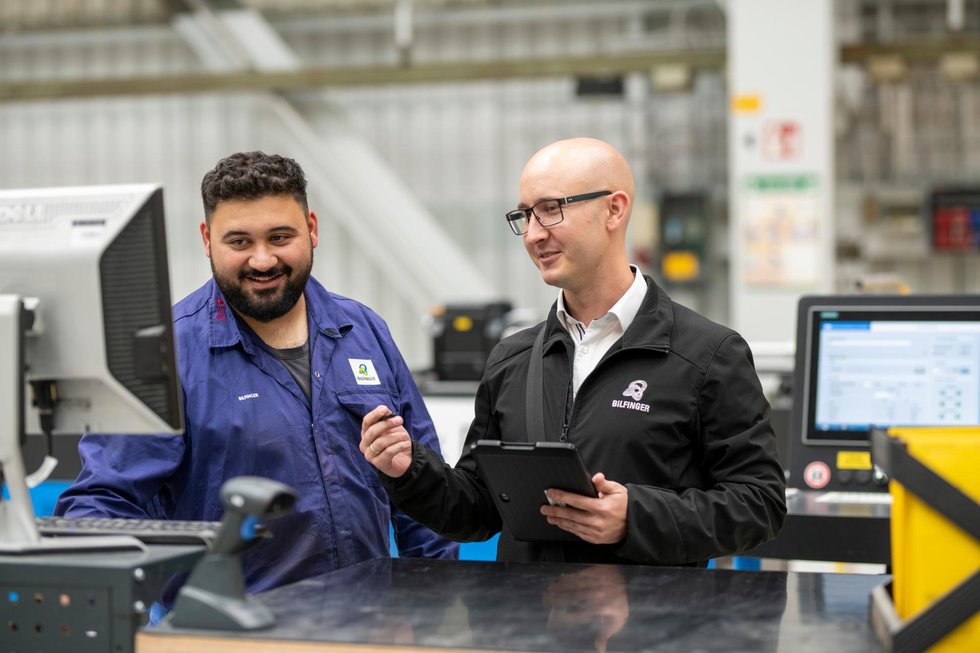
Mobile-enabled workflows allow supervisors and technicians to access schedules, maintenance information, and risk assessments in real time, improving planning, execution, and productivity in the field.
This data-driven approach helps transform maintenance from a reactive break-fix process into a proactive reliability strategy that extends asset life, reduces unplanned downtime, and improves overall operational performance.
Safety as a core value
In high-hazard industrial environments, safety must be embedded in every activity. At Bilfinger, safety is not simply a metric to manage. It is a core organizational value.
Bilfinger BIC Magazine
An integrated model creates a unified safety culture across all work disciplines, reducing the challenges associated with managing multiple contractors operating under different programs and expectations. By partnering with one maintenance provider, facilities gain consistency in training, procedures, supervision, and compliance.
The result is reduced site risk, stronger safety performance, and a shared commitment to ensuring every employee returns home safely at the end of every shift.
Delivering measurable results
The benefits of an integrated maintenance model extend well beyond operational simplicity.
Maintenance costs are often reduced through streamlined contractor management, optimized resource utilization, and fewer delays between work scopes. Reliability improves because teams operate with greater coordination and visibility across the entire maintenance lifecycle.
Turnarounds and major maintenance events also become more efficient. When access, insulation, prefabrication, inspection, and mechanical services are managed through a single point of contact, communication improves, schedules align, and critical-path activities stay on track.
Most importantly, plant operators gain a trusted partner that shares responsibility for safety, reliability, and long-term performance.
Partner with a global leader in industrial services
As a global industrial services provider with more than 140 years of experience, headquartered on the Gulf Coast with offices nationwide, Bilfinger understands the unique challenges industrial operators face and delivers integrated solutions that improve reliability, reduce risk, and enhance performance.
To learn more about how Bilfinger's integrated maintenance model can improve reliability and performance, visit www.bilfinger.com.