
NOTE: The sponsor of this content may contact you with more information on this topic. Click here to opt out from sharing your email address with this sponsor. (This link will not unsubscribe you from any other BIC email list).
Across refineries, oil field facilities, and petrochemical operations, no two fired heaters are exactly alike. Differences in design, operating conditions, and, most importantly, feedstock result in a wide range of fouling behaviors. Consequently, coke formation inside heater coils is seldom uniform, predictable, or consistent from one unit to another. This fundamental reality defines one of the most critical principles in mechanical pigging: adaptability is not optional; it is essential.
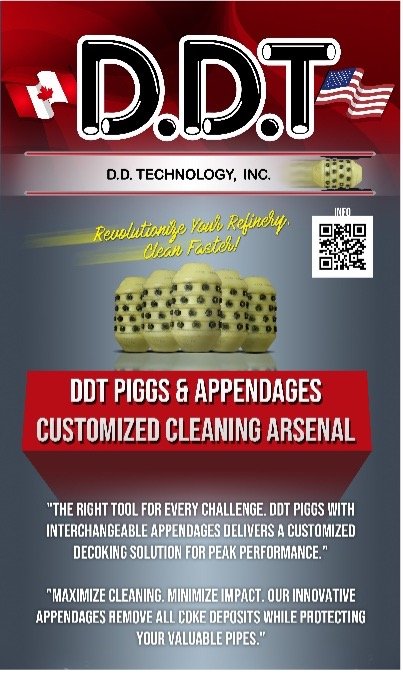
At Decoking Descaling Technology (DDT), our approach to pigging has always been built around this concept. Our proprietary DDT Piggs® are engineered with interchangeable and adjustable appendages, allowing each cleaning run to be tailored to the specific characteristics of the heater and its coke accumulations. Every pigg carries an array of threaded appendages distributed radially to provide full 360° cleaning coverage, while allowing operators to adjust variables such as appendage type, height, and configuration in real time.
The reality of coke variability and why fixed pigging tools fall short
Different refining processes and feedstocks generate different fouling behaviors, and even within a single fired heater, coke hardness, thickness, and adhesion can vary significantly from one section to another. Although severe coke is often associated with high-heat-flux radiant areas, especially in delayed coking service, field experience has shown that in box-type heaters, critical deposits can also develop in less conventional locations such as roof tubes and shock (shield) tubes at the bottom of the convection section.
This variability exposes an important limitation in pigging systems that rely on fixed, non-adjustable appendages. Many conventional tools use aggressive tire-stud-type elements throughout the entire cleaning process, from the first smaller-diameter pigg to the final-size pigg, regardless of how fouling conditions change along the coil.
The problem is that the required cleaning action is often localized, but the aggressive tool configuration is applied everywhere. If the remaining hard coke is located only in a downstream section, the pigg must still pass through upstream tubes that are already clean while carrying that same aggressive appendage profile. The result is that coke removal is targeted, but tube wear is not: unnecessary metal-to-metal contact can occur across every clean tube in the travel path before the pigg even reaches the area that actually requires the higher cleaning force.
This lack of adaptability can lead to two undesirable outcomes: reduced effectiveness in challenging localized deposits and avoidable internal wear, including grooving or rifling, in tubes that no longer require aggressive cleaning. In those situations, controlled adaptability is not just an advantage; it becomes essential for balancing cleaning efficiency with tube integrity.
Engineering adaptability into the pigg
DDT’s solution is rooted in decades Refinery experience and continuous tool development.
Our piggs are designed to adapt progressively throughout the cleaning process, using:
- Fracture appendages to weaken and break coke deposits during the initial stages of pigging, with different configurations selected based on coke hardness
- Scraper appendages on final-size and oversized piggs to remove the remaining coke adhered to the pipe wall
This staged approach allows operators to match the tool to the condition, rather than forcing the condition to fit the tool.
Precision without compromise
A key element of this adaptability is the ability to control appendage type and height, which directly influences cleaning efficiency and the level of contact with the pipe surface. This allows the cleaning action to be adjusted throughout the process, ensuring effective coke removal while maintaining control over mechanical interaction with the tubing.
As a result, DDT Piggs® are capable of:
- Targeted cleaning in high-fouling zones
- Reduced unnecessary abrasion in already cleaned sections
- Navigating tight or sensitive areas with appendages calibrated to final internal dimensions
This level of control enables operators to remove coke effectively while minimizing impact on pipe integrity, even in challenging areas such as roof and shock tubes.
Combined with DDT’s bidirectional control and real-time monitoring, this adaptability helps ensure that cleaning is both effective and controlled, even in demanding furnace environments.
Conclusion
In an industry where every fired heater is different, the success of a pigging operation depends on one key factor: the ability to adapt.
A fixed tool cannot address a variable problem. But an adaptable system, engineered with precision and guided by experience, can.
At D.D.Technology Inc., adaptability is not an added capability. It is the foundation of our pigging technology and the reason we continue to deliver consistent, safe, and high-performance results across demanding fired-heater applications.