
You’ve been there… it’s 2:17 a.m. in a refinery when a transfer pump trips offline.
MELTRIC MEG_CMYK_2017
In a rush, operators adjust flows. Supervisors are on the radio. Maintenance starts mobilizing. Pump failure is not unusual, but it matters how long it takes to safely disconnect, replace, and restart it.
Everyone knows that operations do not pause cleanly. Production backs up, bottlenecks, and ripples through the entire system. Every minute that pump remains offline impacts throughput, unit balance, and delivery commitments.
And so, the tightly orchestrated dance begins. Electricians suit up in arc-rated PPE. Lockout/tagout procedures begin. Energy isolation is verified. Finally comes the physical disconnect of a hardwired or traditional pin-and-sleeve connection, a process that has changed little in decades.
While refineries invest heavily in automation and advanced process controls, one of the most routine maintenance steps, disconnecting and reconnecting a motor, still carries arc-flash risk, procedural complexity, and extended downtime.
In downstream facilities, that is where hidden safety exposure and unnecessary production loss quietly live.
Hiding in plain sight: The traditional electric problem
Across downstream facilities, traditional pin-and-sleeve connectors, twist-lock devices, and hardwired motor connections are still the norm. They are familiar. They are widely accepted. But they introduce operational friction every time a motor or pump needs to be serviced.
While common, these methods introduce three major operational challenges:
1. Arc-flash risk
First, there is arc-flash risk. Disconnecting equipment under load exposes workers to potential arc-flash hazards, which means arc-rated PPE, detailed lockout and tagout procedures, permit documentation, and often multiple personnel involved in what should be a routine task. Arc-flash studies, PPE programs, and NFPA 70E compliance requirements continue to expand in both scope and cost.
2. Extended downtime
Then there is time. A typical motor or pump changeout can stretch to three or four hours once energy isolation is verified, PPE is staged, conductors are disconnected, and systems are rewired and re-terminated. In a refinery, those hours translate directly into lost throughput and mounting production pressure.
3. Additional hardware and installation costs
Finally, there is infrastructure complexity. Traditional installations require separate disconnect switches, interlock systems, additional panel space, and more wiring. Each added component increases capital cost, installation labor, and long-term maintenance exposure. More hardware means more potential failure points.
Individually, these electrical connection burdens are accepted as part of doing business. Most facilities continue to treat them as unavoidable.But, they are avoidable.
A different approach: Switch-rated plugs & receptacles
There is another way to handle that 2:17 a.m. pump failure.
Switch-rated plugs and receptacles combine the plug, the receptacle, and the disconnect switch into a single integrated device. Certified under UL 2682 and approved as NEC line-of-sight motor disconnects, they are engineered to safely connect and disconnect equipment under full electrical load.
That distinction matters.
Instead of relying on separate disconnect hardware and procedural layers to manage arc-flash exposure, a switch-rated device is built to interrupt current internally and contain the arc within a sealed chamber.
The hazard is controlled inside the device, not managed around it with additional equipment and PPE.
What was once a multi-step electrical event becomes a controlled, push-button disconnection. What required layers of hardware becomes a single piece of engineered protection.
Improving safety: How switch-rated plugs & receptacles manage hazards
Switch-rated devices are engineered around a simple principle: contain the hazard at the point of interruption.
Inside the unit, an arc-flash containment chamber extinguishes the arc in milliseconds. Dead-front shutters block access to live conductors. Silver-nickel butt-style contacts maintain constant contact force through thousands of cycles. The push-button mechanism performs the load break in a controlled, enclosed action, with lockout capability built in.
That changes the task itself.
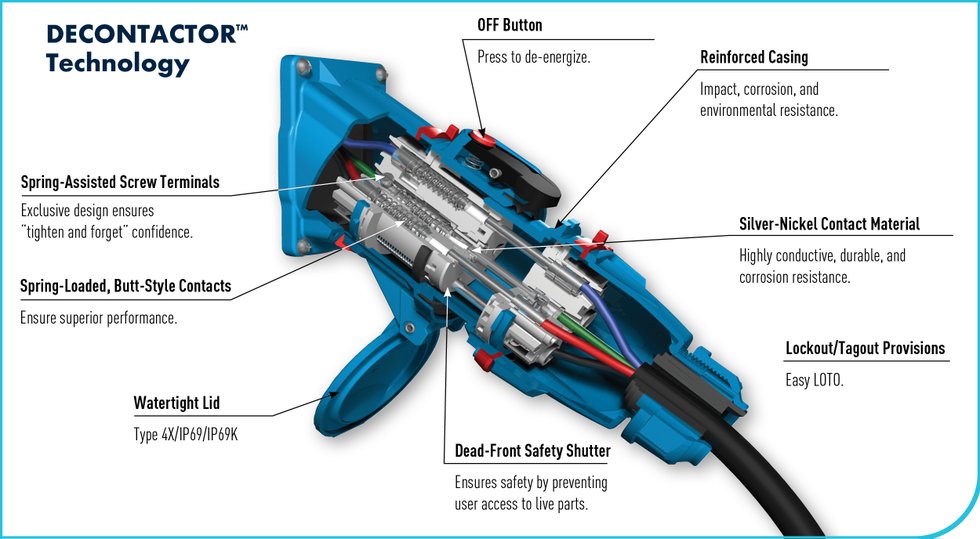
There is no exposed arc flash at disconnection. Operators can visually verify de-energization. In many applications, arc-rated PPE is no longer required simply to unplug equipment.
Under NFPA 70E, eliminating the hazard is always preferable to mitigating it. Switch-rated technology removes arc-flash exposure from one of the most routine maintenance steps in downstream operations.
For EHS leaders, plant managers, and operators that is a meaningful shift in how electrical risk is controlled.
Horsepower rating? Why they matter in real conditions
Not all electrical connections are built for motors.
When motors start, they can draw six to ten times their normal running current. They create electrical stress, inrush current, and voltage spikes that punish weak connections.
A connector without a true horsepower rating may handle steady current. It may even look robust on paper. But under motor startup conditions, it can overheat, weld contacts, or degrade prematurely.
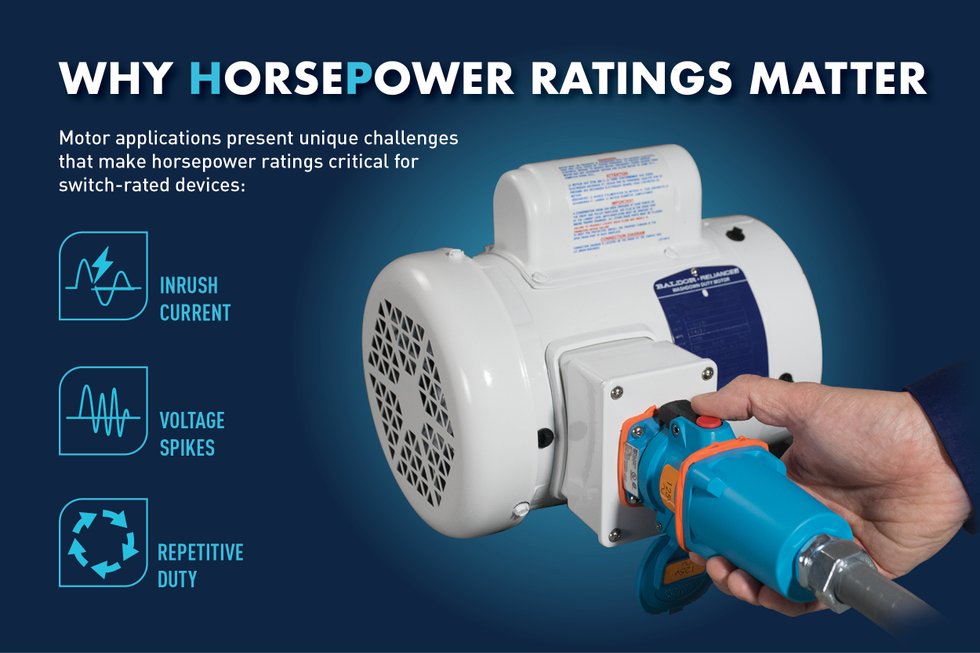
That is why certified horsepower ratings matter.
Switch-rated devices designed for motor start and stop applications are tested to operate under these real-world conditions. For facilities operating crude transfer pumps, cooling tower fans, wastewater motors, compressors, and loading rack systems, this is not a minor detail. It is the difference between a controlled interruption and equipment damage.
Often overlooked: Longterm returns
Switch-rated devices are more than just a safety upgrade, deliver an exceptional return on investment by combining the functionality of a plug and a disconnect in one compact device.
All-in-one: Less downtime
With traditional hardwired and pin-and-sleeve connections, isolating and replacing a motor can mean the loss of hours.
With switch-rated plug-and-play devices, the process changes. The load is interrupted safely at the device. Lockout is applied. The motor is swapped. Power is restored.
What once required extensive electrical rework becomes a controlled mechanical exchange.
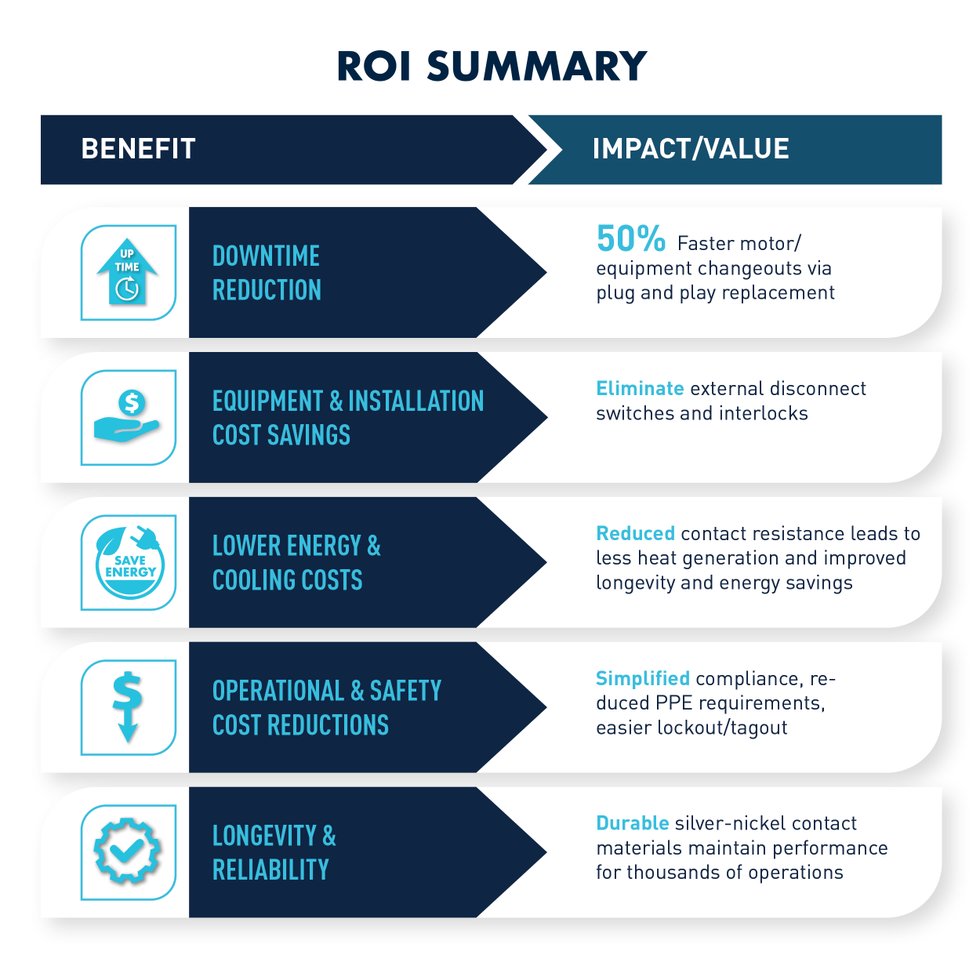
Facilities routinely report up to 50 percent faster motor and pump changeouts. In a refinery environment, that reduction is not incremental. It directly affects throughput, shift efficiency, and production targets.
Downtime is expensive. Reducing it at the connection point is one of the simplest ways to improve it.
Simplified infrastructure: Cost savings
Traditional motor installations require layers of supporting hardware. Separate disconnect switches. Interlocks. Additional wiring. Panel space. Each component adds cost during installation and adds another potential failure point over time.
Because switch-rated devices qualify as line-of-sight motor disconnects under NEC requirements, they eliminate the need for separate disconnect hardware in many applications.
Fewer components mean simpler designs. Simpler designs mean faster installations and fewer long-term maintenance variables.
In large downstream facilities with dozens or hundreds of motors, that simplification scales quickly.
High-quality materials: Lifecycle longevity
Electrical resistance is rarely discussed electrical connection topic, but it quietly affects operating costs.
High-quality switch-rated devices use silver-nickel butt-style contacts that maintain low resistance over thousands of cycles. Lower resistance means less heat generation and reduced I²R losses. Less heat means reduced cooling demand and slower contact degradation.
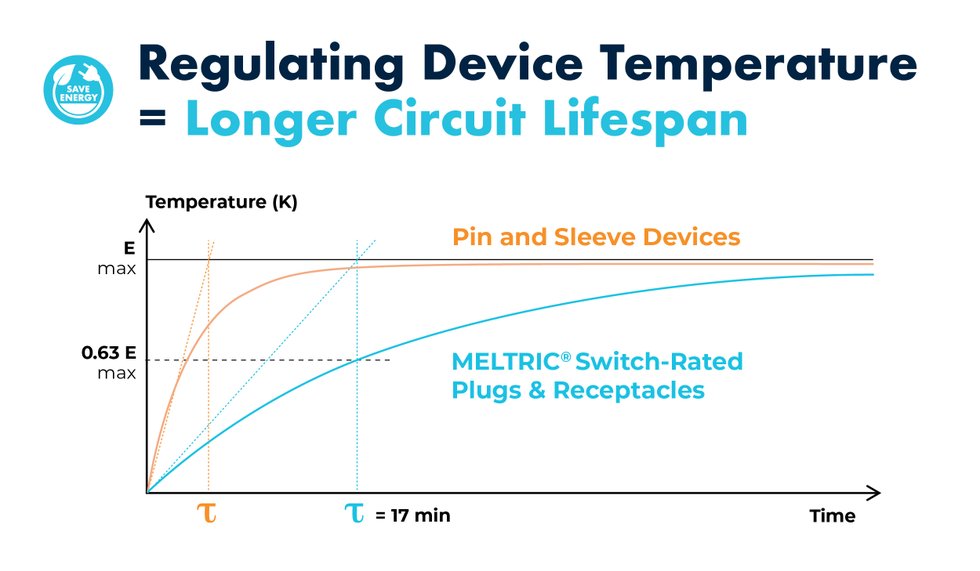
Over time, those efficiency gains compound.
For facilities managing aging infrastructure and rising energy costs, incremental efficiency improvements across dozens of high-amperage connections can produce measurable long-term savings.
Retrofitting doesn’t mean shutting down
A common concern is implementation. Refineries cannot afford sweeping shutdowns simply to upgrade connection points.
Fortunately, upgrades do not require facility-wide overhauls.
Many operators begin by targeting high-risk or high-frequency maintenance areas such as pump stations, blending systems, wastewater units, or loading racks. Pre-assembled cord sets allow rapid equipment-side conversions. Supply-side upgrades can be phased across budget cycles. Temporary adapter assemblies allow compatibility with legacy systems during transition.
The result is flexibility. Facilities can prioritize safety and uptime improvements without waiting for a major turnaround.
Switch-rated plugs & receptacles: A practical shift for downstream operators
Downstream operations face constant pressure to improve safety metrics, reduce downtime, and control capital spending.
Switch-rated technology addresses all three at a point that is often overlooked: the electrical connection itself.
Upgrading to Switch-Rated Plugs and Receptacles is a focused improvement at the intersection of safety and uptime. They reduce arc-flash exposure, they shorten changeout times, they eliminate unnecessary hardware, they improve long-term efficiency, and they simplify compliance.
In facilities where every hour matters and every safety metric is scrutinized, that is a meaningful change.
To learn more about Switch-Rated Plugs and Receptacles, visit meltric.com
To try a FREE Switch-Rated Plug and Receptacle, visit meltric.com/fpo