Every American should ask the question Texas has already answered: Do our policies create more energy and fewer obstacles, or less supply and higher costs?
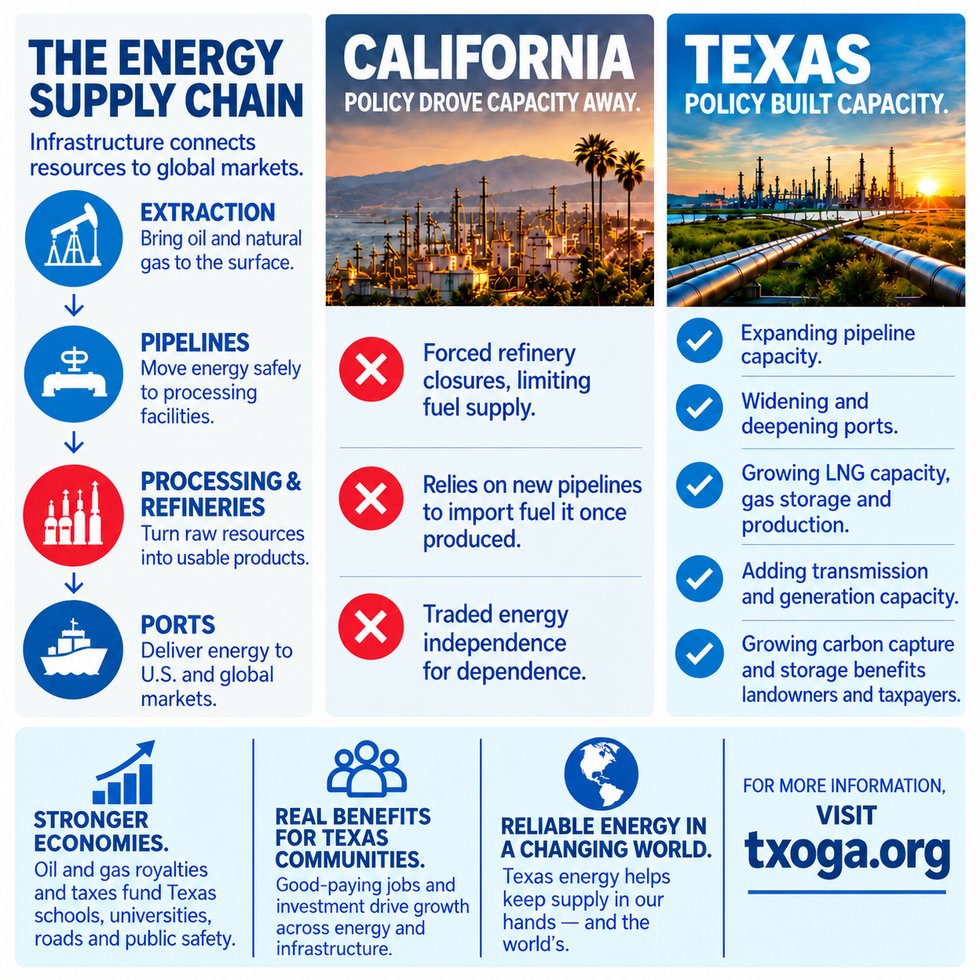
Delivering the energy the world relies on starts with finding and extracting oil and natural gas, then moving it through pipelines, processing facilities, refineries and ports. Every link in the chain depends on infrastructure, and each link is only as strong as the policies that allow it to be built.
California showcased what happens when policy drives capacity away. The state's policies forced the closure of two refineries that would be providing real relief to Americans today had they stayed open.
Now, new pipelines are being built to import fuel California once produced itself. The state traded energy independence for energy dependence.
In Texas, the exact opposite is occurring.
The Lone Star State has embraced pro-business, pro-energy policies that welcome investment rather than chase it away. Pipeline capacity is expanding. Ports are being widened and deepened. LNG capacity, natural gas storage and upstream production continue to grow, and new transmission and generation capabilities are being added. Carbon capture and storage is a growing industry the oil and gas industry is responding to and where Texas landowners and taxpayers are seeing direct benefits.
The benefits go well beyond the energy sector. Billions of dollars in royalties and taxes paid by oil and natural gas companies fund Texas schools, universities, roads and public safety.
As disruptions ripple across global supply chains, Texas' oil and natural gas industry remains focused on supplying our nation, and the world, with reliable energy. That is possible, because Texas chose to invest in the infrastructure that keeps supply in our own hands.
For more information, visit txoga.org.