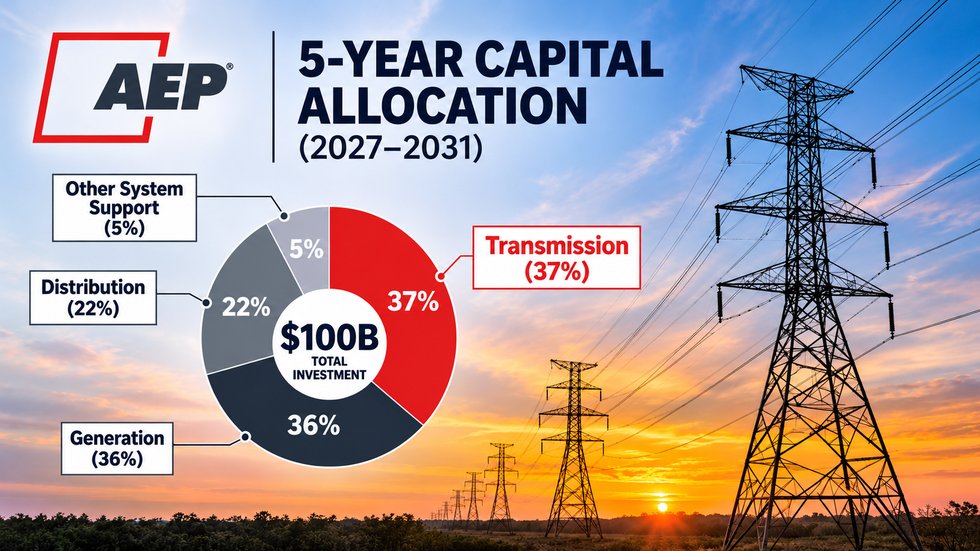
To support unprecedented power demand driven by data centers and industrial expansion, American Electric Power (AEP) has selected engineering and program management giants Jacobs and WSP USA to help execute a massive $37 billion transmission investment program across 11 states.
The strategic delivery partnerships align with AEP’s newly unveiled $100 billion capital investment plan spanning 2027 through 2031. Transmission infrastructure represents the largest share of this allocation—surpassing $36 billion earmarked for generation assets and $22 billion for distribution networks—as the utility prepares to nearly double its transmission rate base to $69 billion by 2031.
Regional execution and scope of work
To streamline execution across its multi-state footprint, AEP has split program delivery into distinct geographic divisions:
- Eastern region (7 States): Jacobs will serve as lead program manager for AEP’s eastern territory. Work is already underway, covering engineering design, project controls, environmental compliance, right-of-way acquisition, and public outreach. Jacobs is managing an integrated team that includes subconsultants ORC (formerly O.R. Colan Associates), GFT (formerly Gannett Fleming TranSystems), and RC Commonwealth.
"Our integrated delivery model will help AEP standardize and scale project delivery across its growing portfolio," said Jacobs Chair and CEO Bob Pragada.
- Western region (4 States): WSP USA will lead project delivery across AEP's western territories, providing comprehensive support across regional system planning, environmental permitting, engineering, and program management.
While neither vendor disclosed individual contract values, the combined assignments represent oversight of a overall $37 billion capital buildout.
Data centers driving massive power load growth
The driving force behind AEP’s historic expansion is an extraordinary surge in commercial power commitments. During Q3 alone, AEP signed 15 GW of new customer load commitments, pushing its total incremental contracted demand projection to 84 GW by 2031.
According to investor presentation metrics, 92% of this incoming demand stems from data centers and high-density compute facilities, including cryptocurrency operations.
To handle this load, AEP plans to nearly triple the mileage of its 765-kV ultra-high-voltage network—a technology line in which AEP already owns approximately 90% of all existing U.S. infrastructure. Of the total $37 billion transmission pipeline:
- $17 billion is designated for Regional Transmission Organization (RTO)-driven projects.
- $11 billion will focus on core grid reliability and asset modernization.
- $9 billion will support dedicated customer-connection infrastructure.
Anchor project: $5B Ohio transmission buildout
Highlighting the scale of this expansion is a $5 billion, 765-kV transmission initiative in southern Ohio. The project is designed to supply power to SB Energy’s planned 10.4-GW data center campus at the former Portsmouth Gaseous Diffusion Plant site in Piketon, Ohio.
AEP finalized commercial contracts for the project in Q3, with field construction slated to start in Q1 2027. Key details of the Piketon development include:
- Capacity & routing: Three separate 765-kV lines—each providing ~3.2 GW of incremental capacity—will connect the Piketon facility with AEP substations near Cheshire and Hanging Rock. Targeted in-service dates span late 2028, 2029, and 2030.
- Commercial terms: Initial load (800 MW) will be served by existing infrastructure. Under a 20-year Electric Service Agreement, the customer will cover the capital project costs directly over two decades following commissioning.
- Regulatory milestones: AEP has secured substantially all necessary right-of-way options and is advancing approval filings with PJM Interconnection, the Public Utilities Commission of Ohio (PUCO), and the Federal Energy Regulatory Commission (FERC).
Additionally, the Department of Energy finalized a $1.6 billion loan guarantee supporting a separate $3.56 billion AEP reliability program to rebuild and reconduct 5,000 miles of high-voltage lines across five states. Subcontracting and procurement opportunities for individual construction packages will be awarded on a project-by-project basis.