When Hurricane Ike struck the Texas coast in 2008, the damage exposed a vulnerability that extended far beyond communities along the shoreline.
The storm caused more than $30 billion in direct damages and an estimated $150 billion in total economic disruption. Nearly two decades later, the concept born in Ike’s aftermath is moving further into engineering and design.
For Sharon Hulgan, Gulf Coast Protection District (GCPD) board member and former Dow site manufacturing director, the need for protection becomes clear when considering what a worstcase storm could mean for industrial facilities.
"The odds of this may be remote, [but] the consequences of it are absolutely unpalatable," Hulgan said.
The Galveston Bay Barrier System, commonly known as the "Ike Dike," is the largest element of the Coastal Texas Project, a coastal storm risk management effort being advanced by the U.S. Army Corps of Engineers (USACE) and GCPD, the project’s non-federal sponsor.
Largest civil construction project in U.S. history moves closer to reality
The barrier system accounts for approximately 85% of the project’s total cost and includes seven features. GCPD is currently advancing two: the Bolivar Roads Gate System, known as "The Gate," and the Bolivar and West Galveston Beach and Dune System, or "Beaches and Dunes."
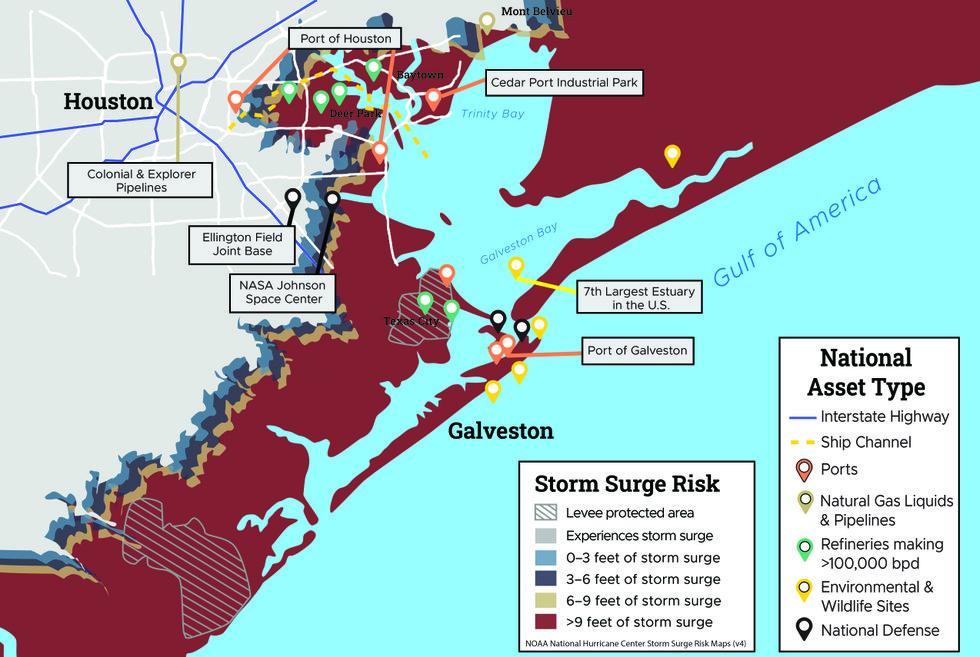
In December 2025, GCPD awarded Jacobs the engineering design contract for The Gate, which would be located along the approximately two-mile-wide waterway between Galveston Island and Bolivar Peninsula. HDR was selected to design Beaches and Dunes, a nature-based feature intended to strengthen coastal barriers. For Gulf Coast industry, the project’s significance extends well beyond the shoreline. Behind the proposed barrier lies the Houston Ship Channel and a concentration of ports, refining and petrochemical facilities, pipelines and other nationally significant assets.
"The Houston Ship Channel is a major artery. It is a pump for the U.S. economy," Hulgan said. "There is a trillion dollars of economy that flows through this channel."
Balancing protection and operations
Designing those protection layers presents another challenge: reducing storm surge risk without unnecessarily disrupting navigation and the supply chain.
As The Gate moves through design, GCPD is examining vessel traffic, channel configurations and vessels ranging from tankers to large cruise ships.
"We have absolutely agreed that this design protection cannot impede two-way traffic. It cannot cause delays in the Ship Channel," Hulgan said.
The next step requires support
Texas has committed $950 million to GCPD, while continued federal funding will be needed as design advances toward construction.
For Hulgan, waiting until another major hurricane demonstrates the need for the project is not an acceptable strategy.
"We would love to create the buzz before the huge storm, and actually build the protection before we need it," she said.
The Coastal Texas Project represents an opportunity to protect communities, critical infrastructure and an industrial corridor that supports the national economy. For Gulf Coast industry, continued engagement and support for funding will be critical to moving it forward.
As Hulgan put it, "You can either pay to protect something, or you can just replace the engine."
For more information, visit gcpdtexas.com.